

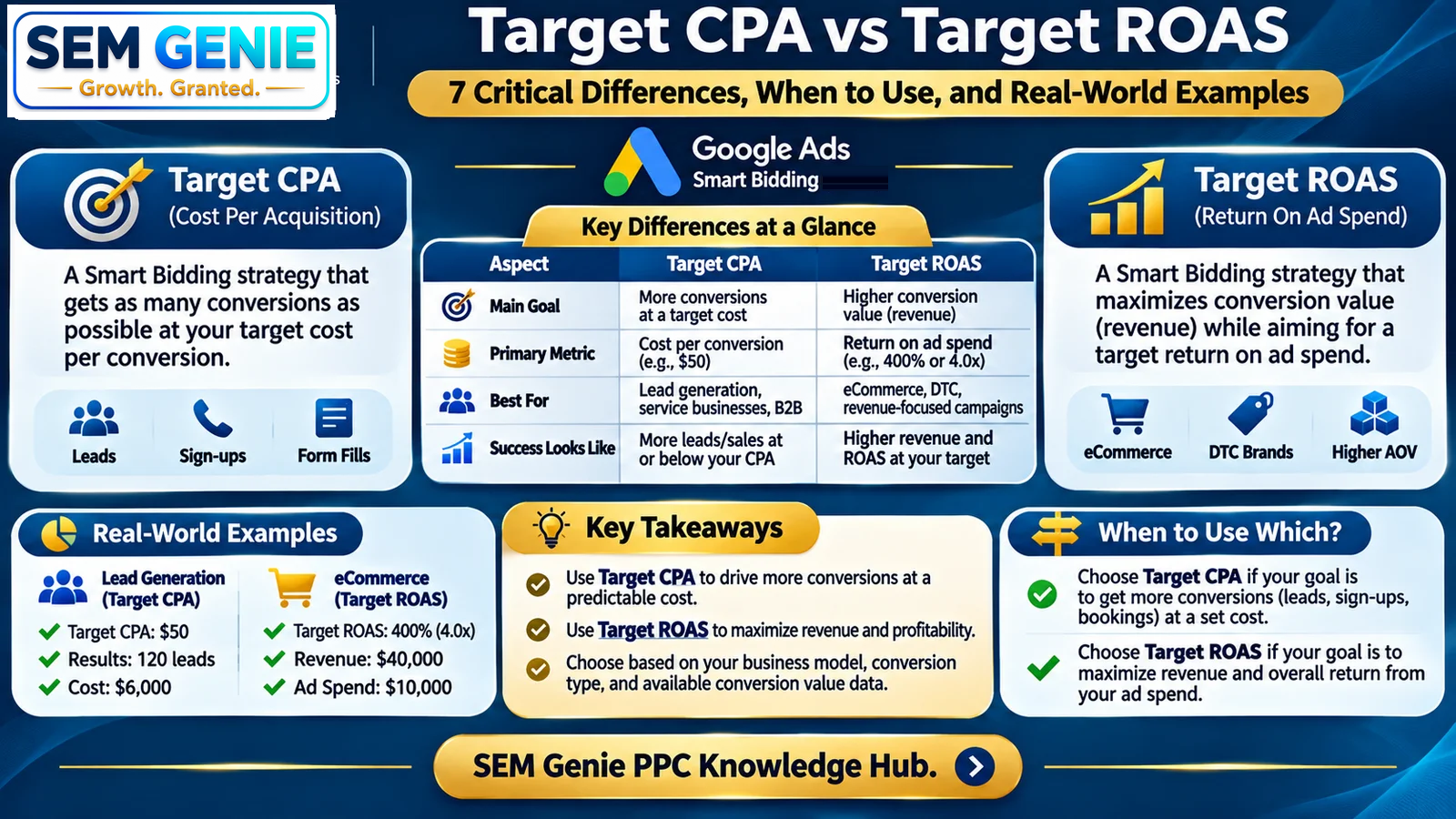
Target CPA vs Target ROAS in Google Ads comes down to what you want Smart Bidding to optimise: the number of conversions at an average cost, or the total value generated relative to advertising spend. Both are automated, auction-time bidding strategies, but they use different signals and suit different business goals.
Target CPA focuses on getting conversions around a desired average cost per conversion. Target ROAS focuses on generating conversion value against a desired return on ad spend. Choosing between them starts with the business outcome you measure and the quality of the conversion data you send to Google Ads.
Target CPA vs Target ROAS: The Main Difference
The simplest distinction is conversion volume versus conversion value. Target CPA is useful when the conversions you want are broadly similar in value and you have an acceptable average acquisition cost. Target ROAS is more suitable when conversion values differ and you want bidding to account for those differences.
If you need a refresher on the underlying metrics, see CPA (cost per acquisition) and ROAS. This guide focuses on the bidding targets, not just the reported results.
| Comparison | Target CPA | Target ROAS |
|---|---|---|
| Main objective | Get more conversions at a target average cost | Get more conversion value at a target return |
| Primary signal | Conversion count | Conversion value |
| Target entered | Currency amount per conversion | Return percentage |
| Best suited to | Leads or actions with broadly similar value | Purchases or leads with different values |
| Key measurement need | Reliable conversion tracking and meaningful primary actions | Reliable conversion tracking plus accurate values |
What Is Target CPA in Google Ads?
Target CPA (cost per action) is a Google Ads Smart Bidding strategy that sets bids to help generate as many conversions as possible at your chosen average cost per conversion. Google evaluates auction-time signals and adjusts bids for each eligible auction to pursue the target.
For example, imagine a lead-generation campaign with a target CPA of $100. Google Ads will use its bidding system to seek conversions at an average cost around that target. Some individual conversions may cost more than $100 and others less; the target is not a hard maximum price for every lead.
When Target CPA makes sense
- You mainly want to increase the number of leads, bookings, sign-ups or purchases.
- The primary conversions you optimise for have broadly similar business value.
- You know the average cost your business can afford for a meaningful conversion.
- Your conversion tracking records the actions that actually matter to the business.
For lead generation, avoid treating every form interaction as equally valuable if some are spam, incomplete enquiries or low-intent actions. Use appropriate primary conversion goals and, where possible, feed qualified outcomes back from your CRM. Otherwise, the bidding system may optimise towards the easiest recorded action rather than the lead your sales team wants.
What Is Target ROAS in Google Ads?
Target ROAS (return on ad spend) is a value-based Smart Bidding strategy. It uses the conversion values you report to Google Ads and adjusts bids to maximise conversion value while aiming for your chosen average return on ad spend.
Suppose an online store spends $1 on ads and wants to generate $5 in tracked conversion value. Its target ROAS would be 500%. If a campaign spends $5,000 and records $25,000 in conversion value, the reported conversion value per cost is 5.0, or 500%.
That value is only as meaningful as the data behind it. If you send order revenue, the metric represents tracked revenue relative to ad cost; it does not automatically represent profit. If you send estimated lead values, the result represents those assigned values rather than verified sales revenue.
When Target ROAS makes sense
- Your conversions have different values, such as orders with different basket sizes.
- You want bidding to prioritise higher-value purchases or leads, not just more conversions.
- You can send accurate, consistent conversion values and currencies.
- You have a clear return target based on margins, fulfilment costs and business economics.
Worked Example: Target CPA vs Target ROAS
Consider two campaigns that each spend $5,000. The numbers below are illustrative and show why the bidding objectives can lead to different decisions.
| Measure | Lead-generation campaign | eCommerce campaign |
|---|---|---|
| Ad cost | $5,000 | $5,000 |
| Conversions | 50 leads | 50 orders |
| Average conversion value | Not used for bidding | $500 |
| Tracked conversion value | Not applicable to this example | $25,000 |
| Actual average CPA | $100 | $100 |
| Conversion value per cost | Not evaluated by this CPA goal | 500% |
If the 50 leads are worth roughly the same amount, a Target CPA goal can be a sensible way to guide bidding. If the 50 orders have very different values, Target ROAS can use those values to distinguish a $40 order from a $1,000 order. A campaign can have an acceptable CPA but still produce a weak return if it mostly attracts low-value orders.
Target CPA or Target ROAS: Which Should You Choose?
Choose Target CPA when conversion count is the priority
For many lead-generation campaigns, a qualified enquiry or booked appointment is the primary outcome and each counted conversion has a similar initial value. In that situation, Target CPA gives the bidding system a clear cost objective. You should still assess lead quality and sales outcomes outside the bidding metric so that a cheap but unsuitable lead is not mistaken for a business success.
Choose Target ROAS when conversion value is the priority
For eCommerce, travel, high-value services and businesses with different deal sizes, conversion values can vary significantly. Target ROAS allows the bidding system to consider those differences. It is particularly useful when a purchase worth $800 should matter more to the business than a purchase worth $30.
What if you do not need a specific target yet?
If your immediate goal is to maximise the number of conversions within the available budget without setting a CPA target, consider Maximise Conversions. If you want to maximise conversion value without specifying a ROAS target, consider Maximise Conversion Value. These are different objectives from applying a target constraint, so choose based on whether a specific efficiency target is genuinely required.
How to Set a Realistic Target CPA or Target ROAS
1. Establish a reliable baseline
Review recent performance over a representative period. For CPA, calculate cost divided by the primary conversions that matter. For ROAS, divide tracked conversion value by cost. Account for conversion delay and avoid setting targets from a short period with unusually strong or weak results.
2. Work backwards from business economics
For Target CPA, consider how much you can afford to pay for a qualified lead or customer after accounting for close rate, gross margin and lifetime value. For Target ROAS, use contribution margin and other variable costs to understand what return is needed to cover more than just media spend. A platform ROAS target is not automatically a profit target.
3. Check conversion tracking and values
Before choosing a target, confirm that conversion actions are configured correctly, duplicate events are controlled, the right actions are included in the primary Conversions goal and values are passed consistently. Read our guide to Google Ads conversion tracking and compare it with your conversion rate before making major bidding changes.
4. Avoid targets that are too restrictive
A target CPA set far below the campaign’s realistic acquisition cost or a target ROAS set far above achievable performance can restrict eligible auctions and reduce volume. Start from observed performance and business requirements, then make measured adjustments. Do not assume a tighter target automatically produces better results.
5. Evaluate quality, not just the platform metric
For lead generation, compare reported conversions with qualified leads, opportunities and closed sales. For eCommerce, review returns, cancellations, discounts and margin where available. The bidding strategy can only optimise the signals and values you provide.
Target CPA vs Target ROAS vs Actual Performance
A target is an instruction to the bidding strategy; an actual metric is the result recorded by the account. They should be reviewed together, but they are not interchangeable.
- Target CPA: the average cost per conversion you ask the strategy to work towards.
- Actual cost per conversion: total ad cost divided by the conversions recorded for the selected reporting scope and period.
- Target ROAS: the average conversion-value-to-cost return you ask the strategy to work towards.
- Actual conversion value per cost: the conversion value reported to Google Ads divided by the relevant ad cost.
Actual performance can move above or below a target over short periods. Conversion delays, auction competition, budget constraints, changes to the website and shifts in conversion rate can all affect the result. Evaluate a period that includes enough conversion activity and allow for the account’s normal conversion lag before deciding that a target is being missed.
Also check which conversion column you are using. The standard Conversions metrics and the All conversions metrics can produce different cost-per-conversion figures because they use different sets of conversion actions. Google’s guide to understanding conversion tracking data explains the distinction.
How the Two Strategies Interpret Conversion Data
Target CPA is primarily concerned with the number of conversions included in the campaign’s bidding goal. If two leads are both counted as one conversion, the strategy does not automatically know that one lead may be worth more to the business than the other. That is why choosing meaningful primary conversion actions matters.
Target ROAS uses the conversion values sent to Google Ads. If one purchase is worth $80 and another is worth $800, the strategy can take that difference into account when deciding how much to bid. This only works as intended when the values are accurate, consistently formatted and representative of business value.
For a lead-generation account, value-based bidding may be appropriate when qualified leads, sales opportunities or closed deals have reliably different values and those values can be passed back to Google Ads. If every form submission is assigned the same arbitrary value, the account is not giving the strategy useful information about which leads are more valuable.
Setting a Target CPA from Your Unit Economics
Start with what the business can afford, not simply the lowest CPA visible in the account. For example, assume a sales team closes 20% of qualified leads and the average first-sale gross profit is $500. The expected gross profit per qualified lead is $100 before other operating and marketing costs (20% × $500). A target CPA below that amount may leave room for those costs; a target above it may require repeat purchases, higher lifetime value or a different margin profile to make the economics work.
This is an illustrative calculation, not a universal benchmark. Use your own close rate, cancellation rate, gross margin, sales costs and customer lifetime value. If the campaign is optimising for raw enquiries rather than qualified leads, adjust the calculation for the proportion of enquiries that become qualified and then become customers.
For example, if only half of form submissions become qualified leads, the allowable cost per raw form submission will be lower than the allowable cost per qualified lead. This is one reason to connect advertising data with CRM outcomes instead of judging every campaign on form volume alone.
Setting a Target ROAS from Margin and Revenue
Revenue-based ROAS is not the same as profit. Suppose a store has a 40% gross margin before advertising and other variable expenses. Ignoring all other costs, it would need $2.50 in revenue for each $1 of ad spend to cover that ad cost from gross profit: $1 ÷ 40% = 2.5, or 250% ROAS. Payment fees, fulfilment, returns, discounts, agency fees and overhead would increase the return required for the business to be profitable.
Use this type of calculation to understand the economics behind a target, then refine it using actual contribution margin and customer value. A target ROAS of 500% can look impressive, but whether it is profitable depends on product costs and the rest of the business model.
If you use estimated values for leads rather than transaction revenue, document how those values are calculated and update them when close rates or deal values change. The strategy will optimise the values it receives; it cannot independently verify your margin or the quality of a lead.
Campaign Eligibility, Conversion History and Readiness
Target CPA and Target ROAS do not have identical setup requirements. Google states that Target CPA can be used without prior conversion history, although a reliable baseline still helps you choose a sensible initial target. Target ROAS requires conversion values, and eligibility or recommended conversion-volume thresholds can vary by campaign type and account. Check the current requirements for the specific campaign before switching strategies.
For Search campaigns using value-based bidding, confirm that conversion values are being reported consistently before adopting a target. If you have recently changed value reporting or the primary conversion actions, allow the new data to accumulate through the relevant conversion cycle before judging performance. See Google’s current Target ROAS guidance for campaign-specific details.
Do not choose a strategy simply because it is available in the interface. Choose it because the campaign has the measurement foundation and business objective that the strategy needs.
A Practical Review Checklist Before Changing Bidding
- Is the campaign optimising for the correct primary conversion actions?
- Are duplicate, test or low-intent actions excluded from the main bidding goal?
- Are conversion values accurate, dynamic where appropriate and sent in the correct currency?
- Does the target reflect recent performance and business economics?
- Have you accounted for conversion lag and reporting delays?
- Are budget and campaign structure suitable for the desired level of volume?
- Will you judge success using qualified leads, revenue or margin—not only the platform target?
Common Mistakes When Using Target CPA and Target ROAS
- Treating the target as a guarantee: Target CPA and Target ROAS are average objectives, not guaranteed results for every day, click or conversion.
- Using the wrong conversion actions: If low-value actions are counted as primary conversions, bidding may optimise towards volume that does not help the business.
- Using inaccurate conversion values: Incomplete or inconsistent values can mislead value-based bidding.
- Setting an unrealistic target: Targets disconnected from historical performance and unit economics can limit reach or volume.
- Changing targets too frequently: Repeated large changes make it harder to evaluate performance and allow the strategy to adapt.
- Confusing ROAS with profit: Conversion value divided by ad cost does not subtract product cost, agency fees, fulfilment, refunds or overhead.
- Judging too early: Recent conversions may still be arriving because of the conversion window and reporting delay.
Google Ads Smart Bidding Terminology in 2026
Google updated the way some Search bidding strategies are labelled in June 2026. The former labels “Maximise Conversions with a Target CPA” and “Maximise Conversion Value with a Target ROAS” are being presented as “Target CPA” and “Target ROAS”. Google states that the underlying bidding behaviour remains the same; the naming change does not require an account change.
Google also announced bidding-system changes for target-based strategies in campaigns limited by budget from 17 August 2026. If a budget-limited campaign’s performance shifts around this period, review the target, budget and official guidance before making abrupt changes. See Google’s current guidance on Target CPA, Target ROAS and Smart Bidding.
Frequently Asked Questions
Is Target CPA the same as actual CPA?
No. Target CPA is the average cost goal used by the bidding strategy. Actual CPA is the cost divided by the conversions recorded over the reporting period. Actual results can be higher or lower than the target.
Is Target ROAS the same as actual ROAS?
No. Target ROAS is the return goal you set. Actual conversion value per cost is calculated from the conversion value reported to Google Ads divided by ad cost. The two can differ.
Can I use Target CPA and Target ROAS at the same time for one campaign?
They are different bidding objectives. A campaign uses a bidding strategy aligned to either conversion volume with a cost target or conversion value with a return target; you do not apply both targets as simultaneous goals for the same bidding strategy.
Is Target ROAS only for eCommerce?
No. It can also suit lead-generation or other businesses when different conversions have meaningful, reliable values. The important requirement is that the values represent differences that matter to the business.
Does Target CPA guarantee that every conversion will stay below my target?
No. The target is an average objective. Some conversions may cost more and others less, and actual performance can vary with competition, conversion rates, budget and other auction-time conditions.
Final Takeaway
Choose Target CPA when the main objective is to generate more meaningful conversions around an acceptable average cost. Choose Target ROAS when conversion values differ and the objective is to maximise value relative to ad spend. In both cases, accurate conversion measurement and realistic business targets matter more than simply choosing the most advanced bidding option.
For help reviewing your bidding strategy, conversion setup or campaign structure, explore PPC consulting, Google Ads management or a Google Ads audit.