

If you’re investing in Google Ads, Meta Ads, Microsoft Advertising, or any other paid advertising platform, one of the most important metrics you should understand is ROAS.
ROAS, or Return on Ad Spend, helps businesses evaluate whether their advertising investment is generating sufficient revenue.
While metrics like clicks, impressions, and click-through rates provide valuable insights into campaign performance, ROAS focuses on what ultimately matters most: revenue.
Understanding ROAS can help businesses make better marketing decisions, optimize advertising budgets, and improve profitability.
In this guide, you’ll learn what ROAS is, how it is calculated, why it matters, and how to improve ROAS across your digital marketing campaigns.
What Is ROAS?
ROAS stands for Return on Ad Spend.
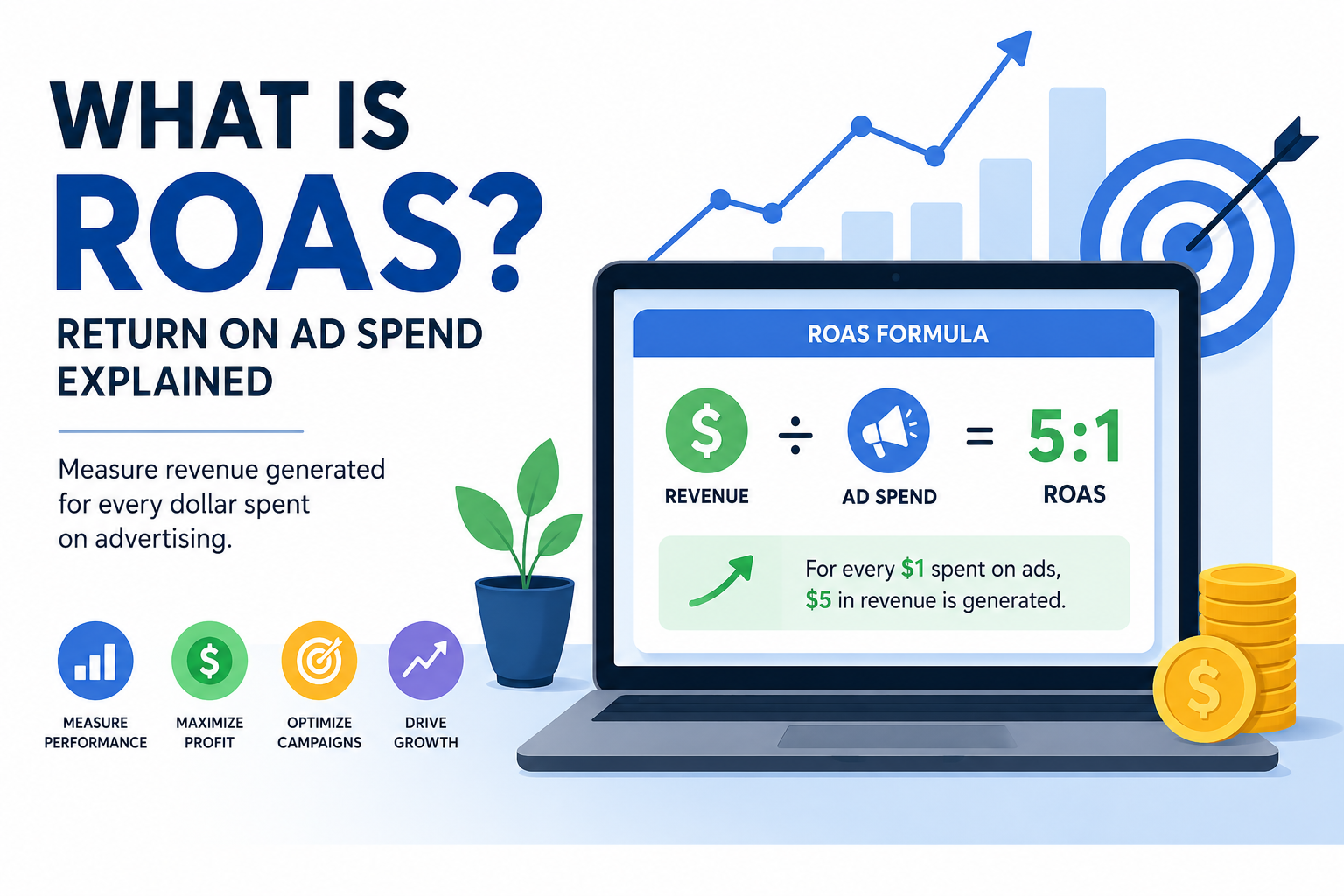
It measures how much revenue is generated for every dollar spent on advertising.
ROAS helps advertisers determine whether their campaigns are profitable and whether advertising budgets are being used effectively.
For example, if you spend:
$1,000 on advertisingand generate:
$5,000 in revenueyour ROAS would be:
5:1This means you generated five dollars in revenue for every dollar spent on advertising.
How Is ROAS Calculated?
ROAS is calculated using a simple formula:
Example
Revenue Generated:
$10,000Advertising Spend:
$2,000Calculation:
10,000 ÷ 2,000 = 5ROAS:
5:1For every $1 spent on advertising, the business generated $5 in revenue.
Why Is ROAS Important?
Many advertisers focus solely on clicks and traffic.
However, traffic alone does not pay the bills.
ROAS helps businesses understand whether advertising campaigns are generating enough revenue to justify their costs.
Benefits of tracking ROAS include:
- Better budget allocation
- Improved profitability
- More effective optimization decisions
- Easier campaign comparison
- Better business forecasting
ROAS provides a clear connection between advertising investment and business outcomes.
What Is a Good ROAS?
There is no universal ROAS benchmark because profitability varies by industry.
Generally:
| ROAS | Interpretation |
|---|---|
| Below 1:1 | Losing money |
| 2:1 | Low profitability |
| 3:1 | Acceptable |
| 4:1 | Good |
| 5:1+ | Excellent |
Many businesses aim for:
4:1or higher.
However, the ideal ROAS depends on profit margins, customer lifetime value, and business objectives.
ROAS vs ROI
ROAS and ROI are often confused, but they measure different things.
ROAS
Focuses specifically on advertising performance.
Formula:
Revenue ÷ Ad SpendROI
Measures overall business profitability.
Formula:
(Profit - Investment) ÷ InvestmentROAS helps optimize campaigns, while ROI evaluates overall business success.
Why ROAS Matters in Google Ads
Google Ads campaigns often generate large volumes of traffic.
Without ROAS tracking, advertisers may struggle to understand whether that traffic is producing revenue.
ROAS helps identify:
- Profitable campaigns
- Underperforming campaigns
- Budget allocation opportunities
- Scaling opportunities
- Keyword profitability
This makes ROAS one of the most important metrics in Google Ads management.
Factors That Influence ROAS
Several factors impact Return on Ad Spend.
Conversion Rate
Higher conversion rates generally improve ROAS because more visitors become customers.
Cost Per Click (CPC)
Lower CPCs often improve ROAS by reducing acquisition costs.
Quality Score
Better Quality Scores can reduce advertising costs while improving visibility.
Landing Page Experience
Well-designed landing pages often improve conversion rates and revenue generation.
Audience Targeting
Reaching the right audience improves campaign efficiency and profitability.
How to Improve ROAS
Improve Conversion Tracking
Accurate conversion tracking helps identify which campaigns generate revenue.
Without reliable data, optimization becomes difficult.
Optimize Keywords
Focus on keywords that generate conversions rather than simply generating traffic.
Remove underperforming keywords and identify growth opportunities.
Use Negative Keywords
Negative keywords help eliminate irrelevant traffic.
This reduces wasted spend and often improves ROAS.
Improve Ad Copy
Relevant ads attract more qualified visitors and improve campaign efficiency.
Optimize Landing Pages
Even small landing page improvements can significantly impact conversion rates.
Focus on:
- Clear messaging
- Strong calls-to-action
- Mobile responsiveness
- Trust signals
- Faster loading speeds
Improve Audience Targeting
Targeting the right audience often produces higher-quality leads and better advertising returns.
Common ROAS Mistakes
Focusing Only on Revenue
High revenue does not always mean high profitability.
Consider margins and operational costs.
Ignoring Conversion Tracking
Poor tracking often leads to inaccurate ROAS calculations.
Scaling Too Quickly
Increasing budgets before campaigns are optimized can reduce efficiency.
Evaluating Campaigns Too Early
Campaigns often require sufficient data before meaningful conclusions can be drawn.
ROAS by Business Type
Ecommerce Businesses
ROAS is often a primary performance metric because revenue can be tracked directly.
Lead Generation Businesses
ROAS calculations may require assigning values to leads and conversions.
SaaS Companies
Customer lifetime value often plays an important role in evaluating ROAS.
Local Businesses
ROAS helps determine whether advertising is generating profitable customer acquisition.
Benefits of Tracking ROAS
Businesses that monitor ROAS effectively can:
- Improve profitability
- Reduce wasted spend
- Make better budget decisions
- Scale successful campaigns
- Improve marketing efficiency
ROAS provides a clear framework for evaluating advertising performance.
Frequently Asked Questions
What is ROAS?
ROAS stands for Return on Ad Spend and measures how much revenue is generated for every dollar spent on advertising.
How do you calculate ROAS?
ROAS is calculated by dividing revenue by advertising spend.
What is a good ROAS?
Many businesses consider a ROAS of 4:1 or higher to be strong, although ideal targets vary by industry and profitability.
Why is ROAS important?
ROAS helps advertisers determine whether campaigns are generating sufficient revenue and profitability.
Can ROAS be improved?
Yes. Better targeting, improved conversion rates, stronger ad copy, effective landing pages, and proper campaign optimization can all improve ROAS.
Final Thoughts
Understanding what ROAS is and how to improve it is essential for successful digital advertising.
While clicks, impressions, and traffic are important, ROAS helps businesses evaluate the true financial impact of their advertising efforts.
By focusing on revenue generation, conversion optimization, audience targeting, and campaign efficiency, businesses can improve ROAS and maximize their return on advertising investment.
Whether you’re managing campaigns internally, working with an agency, or partnering with a PPC consultant, ROAS should be one of the key metrics guiding your advertising decisions.
If you’re unsure whether your campaigns are generating the best possible return, a professional Google Ads audit can help identify opportunities to improve efficiency, reduce wasted spend, and increase profitability.