

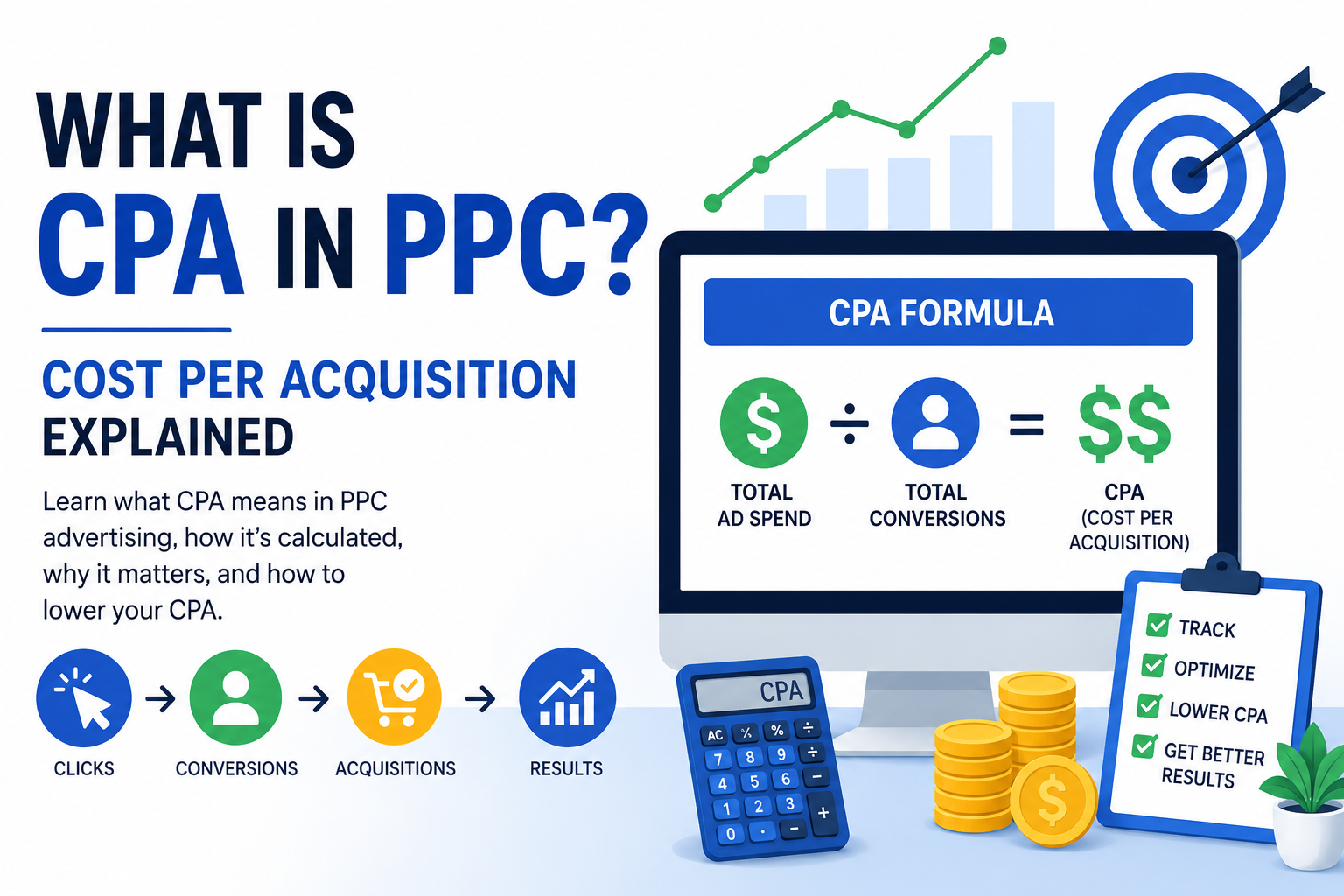
If you’re running Google Ads, one of the most important metrics you should track is CPA.
CPA helps advertisers understand how much it costs to acquire a customer, lead, sale, or conversion through paid advertising.
While clicks, impressions, and click-through rates provide useful performance insights, CPA focuses on what matters most: the actual cost of generating results.
Understanding CPA can help businesses improve profitability, optimize advertising budgets, and make better marketing decisions.
In this guide, you’ll learn what CPA is, how it is calculated, why it matters, and how to lower CPA in your PPC campaigns.
What Is CPA in PPC?
CPA stands for Cost Per Acquisition.
It measures the average amount spent to generate a conversion through paid advertising.
A conversion could be:
- Lead form submission
- Phone call
- Quote request
- Purchase
- Appointment booking
- Newsletter signup
CPA helps advertisers determine whether their campaigns are generating results at an acceptable cost.
How Is CPA Calculated?
CPA is calculated using a simple formula:
Cost Per Acquisition = Total Advertising Cost ÷ Total Conversions
Example
Advertising Spend:
$1,000
Conversions:
20
CPA:
$1,000 ÷ 20 = $50
In this example, it costs $50 to generate each conversion.
Why Is CPA Important?
Many advertisers focus on traffic metrics.
However, traffic alone does not generate revenue.
CPA helps businesses understand:
- How efficiently advertising budgets are being spent
- Which campaigns generate profitable results
- Which keywords drive affordable conversions
- Where optimization opportunities exist
A lower CPA generally means greater advertising efficiency.
What Is a Good CPA?
There is no universal CPA benchmark.
A good CPA depends on:
- Industry
- Product value
- Profit margins
- Customer lifetime value
- Business goals
For example:
| Industry | Typical CPA Range |
|---|---|
| Local Services | $20 – $150 |
| Ecommerce | $10 – $100 |
| B2B Lead Generation | $50 – $500+ |
| Legal Services | $100 – $1,000+ |
The most important factor is profitability.
A $100 CPA may be excellent if a customer generates $1,000 in revenue.
CPA vs CPC
CPA and CPC are often confused.
CPC (Cost Per Click)
Measures how much you pay for a click.
Example:
$2 per click
CPA (Cost Per Acquisition)
Measures how much you pay for an actual conversion.
Example:
$50 per lead
While CPC measures traffic costs, CPA measures business results.
CPA vs ROAS
CPA and ROAS work together.
CPA
Measures cost per conversion.
ROAS
Measures revenue generated from advertising spend.
A campaign may have:
- Low CPA
- High ROAS
which is often an ideal combination.
Advertisers should monitor both metrics when evaluating performance.
Why CPA Matters in Google Ads
Google Ads campaigns generate traffic.
CPA helps determine whether that traffic is converting efficiently.
CPA can be used to:
- Compare campaigns
- Compare keywords
- Evaluate audiences
- Measure profitability
- Guide budget allocation
Many advertisers use Target CPA bidding strategies to automate campaign optimization.
Factors That Influence CPA
Several factors affect CPA performance.
Conversion Rate
Higher conversion rates often reduce CPA.
More conversions from the same traffic means lower acquisition costs.
Cost Per Click
Higher CPCs can increase CPA.
Reducing wasted clicks often improves CPA performance.
Landing Page Experience
Landing pages play a major role in conversion performance.
Factors include:
- Speed
- Mobile friendliness
- Relevance
- Calls-to-action
- Trust signals
Audience Targeting
Showing ads to the wrong audience often increases CPA.
Better targeting usually improves efficiency.
Quality Score
Higher Quality Scores often lower CPCs, which can improve CPA.
How to Reduce CPA
Improve Conversion Tracking
Accurate conversion tracking is essential.
Without reliable data, optimization becomes difficult.
Add Negative Keywords
Negative keywords help eliminate irrelevant traffic.
Benefits include:
- Lower wasted spend
- Better lead quality
- Improved CPA
Improve Landing Pages
Small landing page improvements can significantly impact conversion rates.
Focus on:
- Clear messaging
- Strong calls-to-action
- Fast loading speeds
- Mobile optimization
Optimize Ad Copy
Relevant ads attract more qualified visitors.
Better-qualified visitors often convert at higher rates.
Focus on High-Intent Keywords
Keywords with strong commercial intent typically produce better conversion rates.
Examples include:
- Google Ads consultant
- PPC management services
- Google Ads audit
Common CPA Mistakes
Tracking the Wrong Conversions
Not every conversion has equal value.
Focus on meaningful business outcomes.
Ignoring Lead Quality
A low CPA is not always good if lead quality is poor.
Optimizing Too Early
Campaigns need enough data before major decisions are made.
Ignoring Landing Pages
Many advertisers focus only on ads while overlooking landing page performance.
Benefits of Lower CPA
Businesses that successfully reduce CPA often experience:
- Better profitability
- More conversions
- Improved campaign efficiency
- Better budget utilization
- Greater scalability
Reducing CPA is one of the most effective ways to improve advertising performance.
CPA for Different Business Types
Ecommerce Businesses
CPA measures the cost of generating purchases.
Local Businesses
CPA often measures calls, bookings, or quote requests.
Lead Generation Businesses
CPA tracks qualified leads and inquiries.
B2B Organizations
CPA may track form submissions, demos, or consultations.
Regardless of industry, CPA remains one of the most important PPC metrics.
Frequently Asked Questions
What is CPA in PPC?
CPA stands for Cost Per Acquisition and measures how much it costs to generate a conversion through paid advertising.
How do you calculate CPA?
CPA is calculated by dividing total advertising spend by total conversions.
What is a good CPA?
A good CPA depends on industry, customer value, and profitability goals.
Why is CPA important?
CPA helps advertisers evaluate campaign efficiency and profitability.
How can I lower CPA?
You can lower CPA by improving conversion rates, optimizing targeting, adding negative keywords, improving landing pages, and reducing wasted ad spend.
Final Thoughts
Understanding what CPA is and how to improve it is essential for successful PPC advertising.
While clicks and impressions provide useful performance insights, CPA focuses on the actual cost of generating leads and customers.
Businesses that monitor and optimize CPA can improve profitability, reduce wasted spend, and achieve better advertising results.
Whether you’re managing campaigns yourself or working with a Google Ads consultant, CPA should be one of the core metrics used to evaluate campaign success.
If you’re unsure whether your campaigns are generating conversions efficiently, a professional Google Ads audit can help identify opportunities to lower CPA and improve overall performance.
One-Line FAQ
What is a good CPA in PPC?
A good CPA depends on your industry, profit margins, and customer value, but the goal is to acquire customers at a cost that allows your business to remain profitable. 🚀