

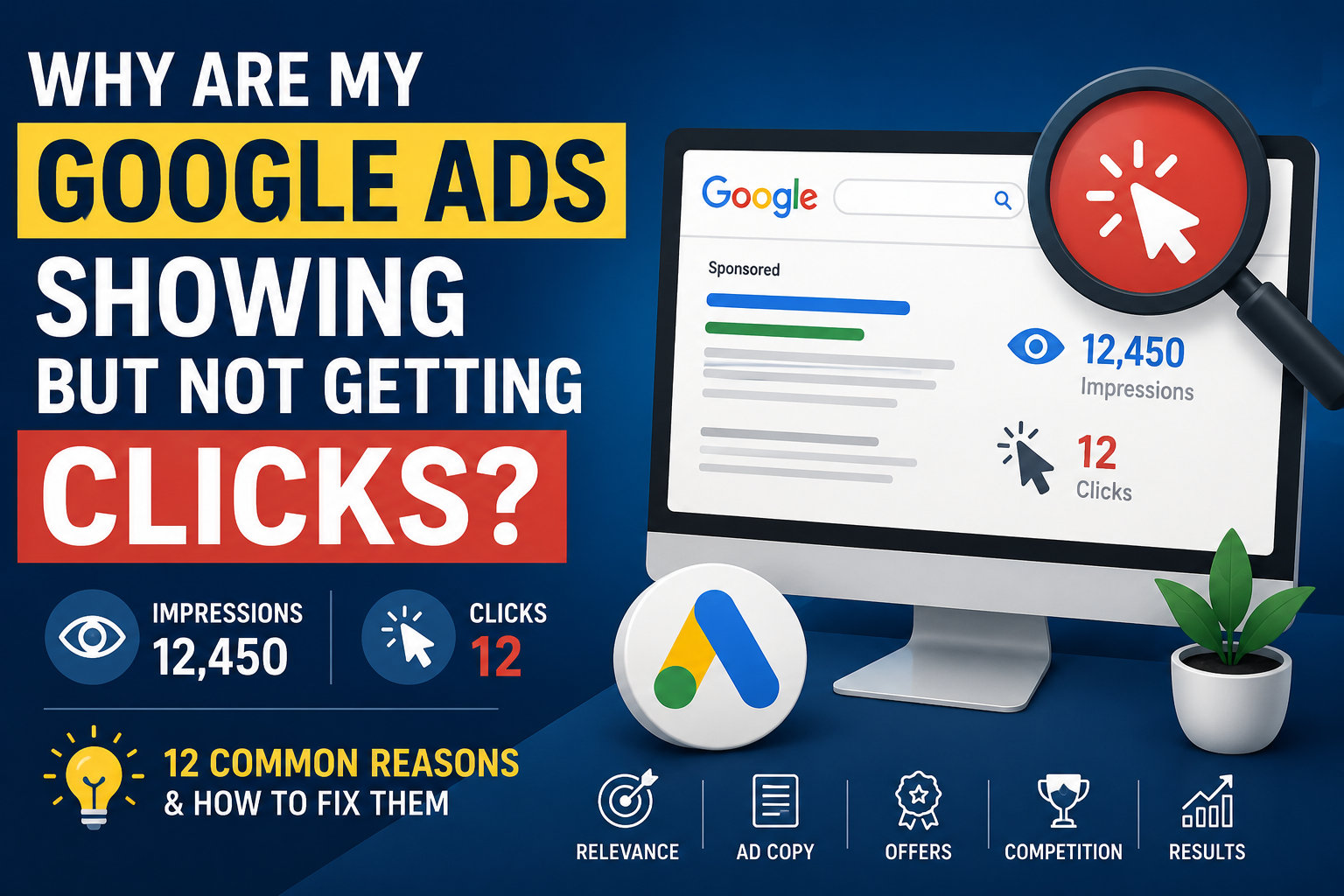
If your Google Ads are receiving impressions but very few clicks, you’re not alone. One of the most common questions advertisers ask is, “Why are my Google Ads showing but not getting clicks?”
At first glance, impressions seem like a good sign. They indicate that Google is displaying your ads to potential customers. However, if people aren’t clicking, something is preventing your ads from standing out or matching what searchers are looking for.
Low click-through rates (CTR) don’t always mean your campaigns are failing, but they do indicate there’s room for improvement. Whether it’s your keywords, ad copy, offer, targeting, or competition, identifying the cause can significantly improve your campaign performance.
In this guide, we’ll explore the most common reasons your Google Ads are showing but not getting clicks—and what you can do to fix them.
1. Your Ads Aren’t Relevant to the Search Query
Google rewards ads that closely match what users are searching for. If your keywords are too broad or your ad copy doesn’t align with the search intent, users are far less likely to click.
For example, someone searching for “Google Ads Consultant for eCommerce” is unlikely to click an ad with a generic headline like “Digital Marketing Services.”
How to fix it
- Create tightly themed ad groups.
- Use keywords in your headlines.
- Match your messaging to the user’s search intent.
- Review your Search Terms Report regularly to identify irrelevant searches.
2. Your Headlines Don’t Grab Attention
Your headline is the first thing users notice. If it doesn’t clearly communicate value or differentiate your business, they’ll likely click a competitor instead.
Weak headline
Google Ads Services
Better headline
Google Ads Consultant with 20+ Years Experience
How to fix it
- Include your primary keyword.
- Highlight your unique selling proposition.
- Add numbers where appropriate.
- Mention benefits instead of features.
3. Your Ad Rank Is Too Low
Even if your ads are eligible to appear, they may be showing in lower positions where they’re less likely to attract clicks.
Google determines Ad Rank using factors such as:
- Bid strategy
- Quality Score
- Expected Click-Through Rate
- Landing page experience
- Ad relevance
Improving these factors often increases visibility without dramatically increasing your bids.
4. Your Offer Isn’t Compelling
Searchers compare multiple ads before clicking. If your competitors offer stronger incentives, they’re more likely to win the click.
Examples of compelling offers include:
- Free Google Ads Audit
- Free Consultation
- No Long-Term Contracts
- Same-Day Response
- 20+ Years Experience
- Dedicated Google Ads Consultant
Your ad should answer one simple question:
“Why should someone click your ad instead of everyone else’s?”
5. You’re Targeting the Wrong Keywords
Not every keyword has buying intent.
For example:
- “What is Google Ads?” attracts people looking for information.
- “Hire Google Ads Consultant” attracts people looking to buy a service.
Focusing on commercial-intent keywords generally results in higher CTR and better-quality traffic.
Don’t forget to use negative keywords to eliminate irrelevant searches.
6. You’re Missing Important Ad Assets
Ad assets (formerly called extensions) increase the size and visibility of your ads while providing additional information to potential customers.
Useful assets include:
- Sitelinks
- Callouts
- Structured Snippets
- Call Extensions
- Image Assets
- Location Extensions
Well-implemented assets can improve both visibility and click-through rates.
7. Your Competitors Have Better Ads
Sometimes the problem isn’t your campaign—it’s your competition.
If competing advertisers have:
- Better offers
- Stronger headlines
- Better reviews
- Recognisable brands
- More compelling calls-to-action
users may simply choose them instead.
Regularly review competitor ads and look for opportunities to differentiate your messaging.
8. Your Brand Isn’t Well Known
People naturally trust brands they’re familiar with.
Large companies often receive more clicks simply because users recognize their name.
Smaller businesses can compete by building trust through:
- Experience
- Customer reviews
- Certifications
- Awards
- Strong guarantees
- Clear value propositions
9. Your Targeting Is Too Broad
Broad targeting often leads to impressions from users who have little interest in your products or services.
Review your targeting settings, including:
- Geographic locations
- Devices
- Audience segments
- Demographics
- Ad scheduling
Showing your ads to a more qualified audience often improves click-through rates.
10. You’re Not Testing Different Ads
One of the biggest mistakes advertisers make is creating a single ad and hoping it performs well.
Successful Google Ads campaigns continuously test:
- Headlines
- Descriptions
- Calls-to-action
- Offers
- Display paths
Even small improvements in messaging can significantly increase CTR over time.
11. Your Ads Promise Too Little
Generic ads rarely inspire action.
Instead of saying:
Professional Google Ads Services
Try something more specific:
- Reduce Wasted Ad Spend
- Google Ads Consultant with 20+ Years Experience
- Free Google Ads Audit
- Generate More Leads & Better ROI
People click benefits—not vague descriptions.
12. You’re Measuring the Wrong Metric
While improving CTR is important, it shouldn’t become your only goal.
A campaign with:
- 3% CTR and high-quality leads
is far more valuable than one with:
- 10% CTR but poor-quality traffic that never converts.
Always evaluate campaigns using metrics such as:
- Conversion Rate
- Cost Per Acquisition (CPA)
- Return on Ad Spend (ROAS)
- Revenue
- Lead Quality
Clicks are only valuable if they lead to business results.
Final Thoughts
If your Google Ads are showing but not getting clicks, increasing your budget isn’t always the answer. More often, the issue lies in ad relevance, keyword selection, targeting, offers, or overall campaign quality.
By improving your headlines, refining your keywords, adding compelling offers, testing multiple ads, and regularly reviewing campaign performance, you can increase your click-through rate while attracting more qualified visitors.
If you’re unsure why your campaigns aren’t generating the clicks they should, a professional Google Ads Audit can uncover hidden opportunities, reduce wasted ad spend, and help your campaigns perform more effectively.
Frequently Asked Questions
Why are my Google Ads getting impressions but no clicks?
The most common reasons include weak ad copy, poor keyword targeting, low ad positions, uncompetitive offers, or strong competition. Improving relevance and testing different ad variations usually helps increase CTR.
Does ad position affect click-through rate?
Yes. Ads appearing higher on the search results page generally receive more clicks, although relevance and compelling messaging are equally important.
Should I increase my bids if I’m not getting clicks?
Not necessarily. Before increasing bids, review your keywords, ad copy, targeting, and offers. Improving relevance often delivers better results than simply spending more.
Can Quality Score improve CTR?
Quality Score itself doesn’t directly increase CTR, but improving ad relevance, expected CTR, and landing page experience often leads to better ad positions and increased visibility.
Is a high CTR always a good thing?
Not always. A high CTR is valuable only if those clicks generate qualified leads, sales, or other meaningful business outcomes. Focus on overall campaign profitability rather than CTR alone.