

Table of Contents
- Introduction
- Why Choosing the Right Advertising Platform Matters
- What Is Google Ads?
- What Are Meta Ads?
- What Is Microsoft Advertising?
- Google Ads vs Meta Ads vs Microsoft Advertising: Quick Comparison
- Google Ads vs Meta Ads
- Google Ads vs Microsoft Advertising
- Meta Ads vs Microsoft Advertising
- Which Platform Is Best for Different Businesses?
- Can You Use More Than One Advertising Platform?
- Frequently Asked Questions
- Final Thoughts
Introduction
Choosing the right advertising platform can have a significant impact on your business’s online success. With multiple paid advertising options available, many business owners ask the same question: Google Ads vs Meta Ads vs Microsoft Advertising, which platform is best for my business?
The answer depends on your goals, target audience, budget, and the type of products or services you offer. While all three platforms help businesses reach potential customers, they work in very different ways and are designed for different stages of the customer journey.
Google Ads helps businesses reach people actively searching for products or services, making it one of the most effective platforms for lead generation and sales. Meta Ads (Facebook and Instagram) excel at building brand awareness, reaching highly targeted audiences, and generating demand through visual advertising. Microsoft Advertising (formerly Bing Ads) offers access to a valuable audience across Bing, Yahoo, and other Microsoft partner networks, often with lower competition and lower cost-per-click.
Understanding these differences is essential before investing your advertising budget. Choosing the wrong platform can lead to wasted ad spend, poor-quality leads, and disappointing results, while selecting the right platform can improve conversion rates, generate more qualified leads, and maximize your return on investment (ROI).
In this comprehensive comparison, we’ll explore the strengths, weaknesses, costs, targeting options, and ideal use cases for each platform. By the end of this guide, you’ll understand the key differences between Google Ads, Meta Ads, and Microsoft Advertising, helping you choose the platform that best aligns with your business goals.
Whether you’re a small business owner, an eCommerce store, a B2B company, or a marketing professional, this guide will help you make a more informed advertising decision.
Why Choosing the Right Advertising Platform Matters
Many businesses assume that advertising success depends on having a larger budget. In reality, success often comes from choosing the right platform for your audience and business goals.
Each advertising platform serves a different purpose within the customer journey. Some platforms are designed to capture people actively searching for products or services, while others focus on creating awareness and generating interest before customers even begin searching.
Choosing the wrong platform can result in:
- Wasted advertising budget
- Low-quality leads
- Poor conversion rates
- Higher Cost Per Acquisition (CPA)
- Lower Return on Ad Spend (ROAS)
On the other hand, selecting the right platform can help you:
- Reach the right audience at the right time
- Generate more qualified leads
- Increase sales and revenue
- Improve conversion rates
- Maximize your advertising ROI
For example, if someone searches “Google Ads Consultant”, they’re already looking for a solution. Platforms like Google Ads and Microsoft Advertising allow you to capture this high-intent traffic because users are actively searching for your services.
In contrast, a business promoting a new clothing brand or fitness app may achieve better results with Meta Ads, where visually engaging content can introduce products to people who may not yet be searching for them.
This doesn’t mean one platform is better than another. Instead, each platform has unique strengths depending on your industry, objectives, budget, and target audience.
Understanding how each platform works and when to use it, is essential for building a successful digital advertising strategy.
In the following sections, we’ll compare Google Ads, Meta Ads, and Microsoft Advertising across audience intent, targeting, costs, lead generation, eCommerce performance, and overall business suitability to help you choose the platform that best fits your marketing goals.
What Is Google Ads?
Google Ads is Google’s online advertising platform that allows businesses to promote their products and services across Google Search, YouTube, Google Shopping, Google Maps, Gmail, and millions of websites within the Google Display Network.
Unlike many other advertising platforms, Google Ads focuses on user intent. People using Google are actively searching for information, products, or services, making them more likely to convert into leads or customers.
For example, if someone searches for “Google Ads Consultant” or “PPC Management Services,” they’re already looking for a solution. This high purchase intent is one of the biggest reasons why Google Ads is considered one of the most effective platforms for lead generation and sales.
Google Ads supports multiple campaign types, including:
✔ Search Campaigns
✔ Performance Max Campaigns
✔ Shopping Campaigns
✔ Display Campaigns
✔ Video Campaigns (YouTube)
✔ Demand Generation Campaigns
Businesses can target customers using keywords, locations, devices, audiences, demographics, and remarketing, allowing advertisers to reach the right people at the right stage of the buying journey.
Google Ads is particularly effective for:
✔ Local businesses
✔ Professional services
✔ B2B companies
✔ eCommerce stores
✔ Healthcare providers
✔ Education businesses
✔ Home services
✔ Lead generation campaigns
One of the biggest advantages of Google Ads is that advertisers only pay when someone clicks on their advertisement. Combined with accurate conversion tracking and continuous campaign optimization, businesses can measure performance, improve ROI, and scale successful campaigns over time.
For businesses looking to capture high-intent customers who are actively searching for products or services, Google Ads is often the strongest advertising platform available.
What Are Meta Ads?
Meta Ads is Meta’s advertising platform that enables businesses to advertise across Facebook, Instagram, Messenger, and the Meta Audience Network.
Unlike Google Ads, which targets people actively searching for products or services, Meta Ads focuses on helping businesses reach potential customers based on their interests, behaviours, demographics, and online activity.
This makes Meta Ads an excellent platform for creating awareness, building brand recognition, and generating demand before customers begin searching for a product or service.
Businesses can target audiences using factors such as:
✔ Interests
✔ Age and gender
✔ Location
✔ Occupation
✔ Online behaviour
✔ Custom audiences
✔ Lookalike audiences
Meta Ads supports a wide variety of campaign objectives, including:
✔ Brand Awareness
✔ Website Traffic
✔ Lead Generation
✔ Sales
✔ App Promotion
✔ Engagement
✔ Video Views
Because Meta platforms are highly visual, businesses can use images, videos, carousels, stories, and reels to capture attention and encourage user engagement.
Meta Ads is particularly effective for:
✔ eCommerce businesses
✔ Fashion and lifestyle brands
✔ Restaurants
✔ Fitness and wellness businesses
✔ Beauty brands
✔ Mobile apps
✔ Businesses focused on brand awareness
While Meta Ads can generate leads and sales, users are generally not searching for a product at the time they see an advertisement. Instead, businesses use engaging creative content to attract attention and move potential customers through the buying journey.
For businesses looking to increase brand visibility, build an audience, and generate demand through visually engaging advertising, Meta Ads is a powerful marketing platform.
What Is Microsoft Advertising?
Microsoft Advertising, formerly known as Bing Ads, is Microsoft’s online advertising platform that allows businesses to display ads across the Bing search engine, Yahoo, AOL, DuckDuckGo (through Microsoft partnerships in some regions), and the Microsoft Audience Network.
Like Google Ads, Microsoft Advertising focuses on search intent, meaning your ads are shown to users who are actively searching for products or services. This makes it an excellent platform for businesses looking to generate qualified leads and sales.
One of the biggest advantages of Microsoft Advertising is its lower competition compared to Google Ads. In many industries, advertisers experience lower Cost Per Click (CPC), allowing them to generate more clicks and conversions for the same advertising budget.
Microsoft Advertising offers campaign types similar to Google Ads, including:
✔ Search Campaigns
✔ Shopping Campaigns
✔ Performance Max Campaigns
✔ Audience Campaigns
✔ Remarketing Campaigns
Businesses can target users based on:
✔ Keywords
✔ Location
✔ Device
✔ Demographics
✔ Audiences
✔ LinkedIn Profile Targeting (for selected campaign types)
Microsoft Advertising is particularly effective for:
✔ B2B businesses
✔ Professional services
✔ Financial services
✔ Technology companies
✔ Local businesses
✔ eCommerce stores
An additional advantage is that businesses already running Google Ads can often import their campaigns directly into Microsoft Advertising, making it quick and easy to expand their reach without rebuilding campaigns from scratch.
Although Microsoft Advertising has a smaller market share than Google Ads, it reaches millions of users who prefer Microsoft products and devices. For many businesses, adding Microsoft Advertising alongside Google Ads can increase overall reach while maintaining strong lead quality and lowering advertising costs.
For businesses targeting high-intent search traffic with potentially lower competition and lower CPCs, Microsoft Advertising is an excellent addition to a PPC strategy.
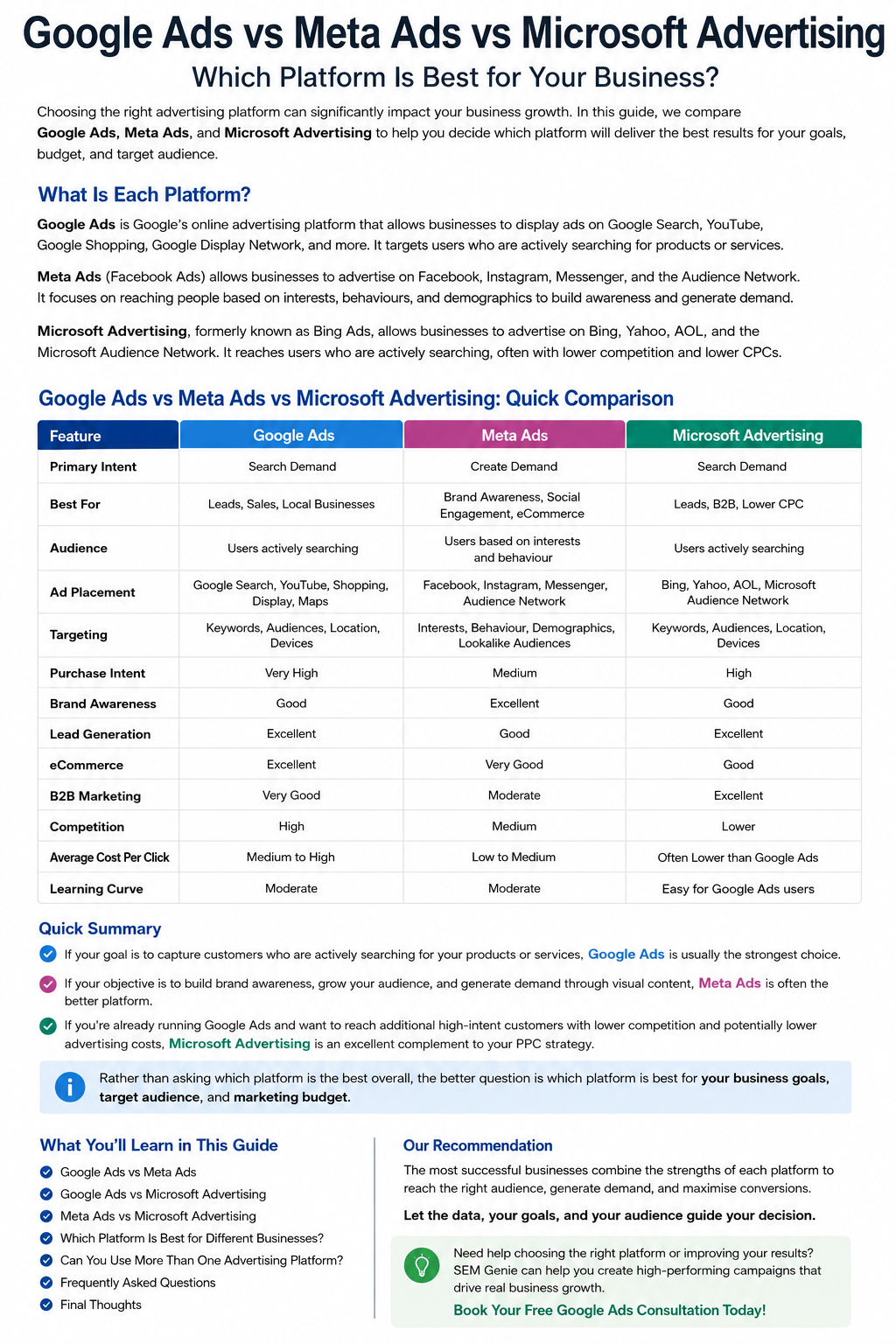
Google Ads vs Meta Ads vs Microsoft Advertising: Quick Comparison
| Feature | Google Ads | Meta Ads | Microsoft Advertising |
|---|---|---|---|
| Primary Intent | Search Demand | Create Demand | Search Demand |
| Best For | Leads, Sales, Local Businesses | Brand Awareness, Social Engagement, eCommerce | Leads, B2B, Lower CPC |
| Audience | Users actively searching | Users based on interests and behaviour | Users actively searching |
| Ad Placement | Google Search, YouTube, Shopping, Display, Maps | Facebook, Instagram, Messenger, Audience Network | Bing, Yahoo, AOL, Microsoft Audience Network |
| Targeting | Keywords, Audiences, Location, Devices | Interests, Behaviour, Demographics, Lookalike Audiences | Keywords, Audiences, Location, Devices |
| Purchase Intent | Very High | Medium | High |
| Brand Awareness | Good | Excellent | Good |
| Lead Generation | Excellent | Good | Excellent |
| eCommerce | Excellent | Very Good | Good |
| B2B Marketing | Very Good | Moderate | Excellent |
| Competition | High | Medium | Lower |
| Average Cost Per Click | Medium to High | Low to Medium | Often Lower than Google Ads |
| Learning Curve | Moderate | Moderate | Easy for Google Ads users |
Quick Summary
If your goal is to capture customers who are actively searching for your products or services, Google Ads is usually the strongest choice.
If your objective is to build brand awareness, grow your audience, and generate demand through visual content, Meta Ads is often the better platform.
If you’re already running Google Ads and want to reach additional high-intent customers with lower competition and potentially lower advertising costs, Microsoft Advertising is an excellent complement to your PPC strategy.
Rather than asking which platform is the best overall, the better question is which platform is best for your business goals, target audience, and marketing budget.
Google Ads vs Meta Ads
Google Ads and Meta Ads are two of the most popular digital advertising platforms, but they serve different purposes and reach customers at different stages of the buying journey.
The biggest difference is user intent.
With Google Ads, people actively search for products or services. They already have a need and are looking for a solution. For example, someone searching for “Google Ads Consultant”, “PPC Management Services,” or “Running Shoes Near Me” is showing clear buying intent.
Meta Ads work differently. Instead of waiting for users to search, Facebook and Instagram display advertisements based on interests, behaviours, demographics, and online activity. This allows businesses to introduce their products or services to people who may not yet be looking for them.
Google Ads Advantages
✔ High purchase intent
✔ Excellent for lead generation
✔ Ideal for local businesses
✔ Strong conversion rates
✔ Measurable return on investment
✔ Multiple campaign types including Search, Shopping, Performance Max, Display, and YouTube
Meta Ads Advantages
✔ Outstanding audience targeting
✔ Excellent for brand awareness
✔ Highly visual advertising
✔ Strong social engagement
✔ Effective remarketing
✔ Great for introducing new products and services
Which Businesses Benefit Most?
Choose Google Ads if you:
✔ Want qualified leads
✔ Offer professional services
✔ Run a local business
✔ Sell products people actively search for
✔ Want measurable sales and ROI
Choose Meta Ads if you:
✔ Want to build brand awareness
✔ Sell visually appealing products
✔ Run an eCommerce business
✔ Launch new products
✔ Want to grow your audience before they begin searching
Can Google Ads and Meta Ads Work Together?
Absolutely.
Many successful businesses use both platforms as part of a complete digital marketing strategy.
For example, Meta Ads can introduce your brand to new audiences through engaging images and videos, while Google Ads captures those same users later when they begin actively searching for your products or services.
Rather than competing against each other, Google Ads and Meta Ads often complement one another by supporting different stages of the customer journey.
Verdict
If your primary objective is generating qualified leads and sales from people actively searching for your services, Google Ads is generally the stronger platform.
If your goal is increasing brand awareness, building an audience, and generating demand through visual content, Meta Ads is often the better choice.
For many businesses, the most effective strategy is not choosing one platform over the other, but combining both to increase visibility, generate demand, and capture high-intent customers throughout the buying journey.
Google Ads vs Microsoft Advertising
Google Ads and Microsoft Advertising are both search-based advertising platforms, making them more similar to each other than either is to Meta Ads. Both allow businesses to reach users who are actively searching for products or services, helping generate high-quality leads and conversions.
The biggest difference lies in market share, audience reach, and competition.
Google Ads dominates the search advertising market, giving businesses access to billions of daily searches across Google Search, YouTube, Google Shopping, Maps, and the Google Display Network. This makes it the preferred choice for advertisers looking to maximize visibility and reach.
Microsoft Advertising, while smaller, reaches users across Bing, Yahoo, AOL, and the Microsoft Audience Network. Although the audience is smaller, advertisers often benefit from lower competition and lower Cost Per Click (CPC).
Google Ads Advantages
✔ Largest search engine audience
✔ Higher search volume
✔ Advanced campaign types
✔ Extensive audience targeting
✔ Excellent for local and global businesses
✔ Strong eCommerce and lead generation capabilities
Microsoft Advertising Advantages
✔ Lower competition
✔ Often lower CPCs
✔ High-quality search traffic
✔ Easy campaign import from Google Ads
✔ Strong B2B audience
✔ LinkedIn profile targeting for selected campaign types
Which Businesses Benefit Most?
Choose Google Ads if you:
✔ Want maximum reach
✔ Need higher search volumes
✔ Run Shopping or Performance Max campaigns
✔ Want access to Google’s full advertising ecosystem
✔ Need advanced campaign automation
Choose Microsoft Advertising if you:
✔ Want to reduce advertising costs
✔ Target B2B customers
✔ Already run Google Ads campaigns
✔ Want to expand your reach with minimal additional effort
✔ Want to reach audiences using Microsoft products and services
Can Google Ads and Microsoft Advertising Work Together?
Yes.
Many businesses run both platforms simultaneously.
Since campaign structures are very similar, advertisers can often import Google Ads campaigns directly into Microsoft Advertising and reach additional customers without creating campaigns from scratch.
Using both platforms allows businesses to increase search visibility while potentially reducing overall acquisition costs.
Verdict
If you’re choosing only one search advertising platform, Google Ads is usually the better option because of its larger audience, greater search volume, and broader range of campaign types.
However, businesses already investing in Google Ads should strongly consider adding Microsoft Advertising. It provides access to additional high-intent customers, often at a lower Cost Per Click, making it an excellent complement to an existing Google Ads strategy.
Meta Ads vs Microsoft Advertising
Meta Ads and Microsoft Advertising serve different purposes, making the better choice dependent on your business objectives.
Meta Ads is designed to help businesses build brand awareness, engage audiences, and generate demand through visually appealing advertisements on Facebook and Instagram. Microsoft Advertising, on the other hand, focuses on capturing users who are actively searching for products or services through Bing and its partner networks.
If your business relies on visual storytelling, product discovery, and audience engagement, Meta Ads is often the stronger platform. If your goal is to generate qualified leads from users with high purchase intent, Microsoft Advertising is typically the better option.
Meta Ads Advantages
✔ Excellent audience targeting
✔ Strong brand awareness campaigns
✔ Highly visual advertising formats
✔ Advanced remarketing capabilities
✔ Ideal for social engagement
✔ Effective for introducing new products and services
Microsoft Advertising Advantages
✔ High-intent search traffic
✔ Lower competition
✔ Often lower Cost Per Click (CPC)
✔ Excellent for lead generation
✔ Strong B2B audience
✔ Easy integration with existing Google Ads campaigns
Which Businesses Benefit Most?
Choose Meta Ads if you:
✔ Sell fashion, beauty, lifestyle, or consumer products
✔ Want to increase brand awareness
✔ Launch new products or services
✔ Want to grow an engaged online audience
✔ Rely on images and videos to attract customers
Choose Microsoft Advertising if you:
✔ Offer professional services
✔ Target B2B decision-makers
✔ Want qualified leads rather than social engagement
✔ Already advertise on Google Ads
✔ Want to reduce advertising costs while expanding search coverage
Can Meta Ads and Microsoft Advertising Work Together?
Yes.
Many businesses use Meta Ads to build awareness and generate interest, while Microsoft Advertising captures users later when they begin searching for products or services.
This combination allows businesses to engage potential customers at multiple stages of the buying journey, from initial discovery to final conversion.
Verdict
If your primary objective is brand awareness, audience growth, and visual storytelling, Meta Ads is generally the better choice.
If your goal is generating qualified leads from users actively searching for solutions, Microsoft Advertising offers a stronger opportunity with lower competition and potentially lower advertising costs.
The right choice ultimately depends on your business goals, target audience, and overall marketing strategy.
Which Platform Is Best for Different Businesses?
There isn’t a single advertising platform that’s best for every business. The right choice depends on your industry, target audience, marketing objectives, and budget.
Here’s a simple guide to help you choose the most suitable platform.
Local Businesses
Examples include plumbers, electricians, dentists, lawyers, accountants, and home service providers.
Best Choice: Google Ads
People searching for local services usually need immediate assistance. Google Ads allows you to appear when potential customers search for services in your area, making it one of the most effective platforms for local lead generation.
Microsoft Advertising can also be a valuable addition, especially for businesses looking to reach additional search users with lower competition.
eCommerce Businesses
Examples include online stores selling clothing, electronics, furniture, beauty products, or home décor.
Best Choice: Google Ads + Meta Ads
Google Shopping campaigns help capture customers who are actively searching to buy products, while Meta Ads introduce products to new audiences through engaging images and videos.
Using both platforms together often produces the strongest results.
B2B Companies
Examples include software companies, consultants, agencies, manufacturers, and professional service providers.
Best Choice: Google Ads + Microsoft Advertising
Business decision-makers frequently use search engines when researching products and services. Both Google Ads and Microsoft Advertising allow businesses to reach users with strong purchase intent.
Microsoft Advertising can be particularly effective because of its professional audience and lower advertising competition.
Startups
New businesses often need to build awareness while generating their first customers.
Best Choice: Meta Ads + Google Ads
Meta Ads help introduce your brand to potential customers, while Google Ads captures demand from users already searching for solutions.
Combining both platforms can accelerate business growth.
Brand Awareness Campaigns
If your primary goal is increasing visibility rather than generating immediate sales, Meta Ads is usually the strongest option.
Facebook and Instagram provide highly visual advertising formats that help businesses reach large audiences and build brand recognition.
Businesses Focused on Lead Generation
If generating enquiries, phone calls, or quote requests is your primary objective, Google Ads is generally the best platform.
Its ability to reach people actively searching for your products or services often results in higher-quality leads and better conversion rates.
Our Recommendation
Rather than choosing a single platform, many successful businesses combine multiple advertising platforms as they grow.
A common strategy is to use:
✔ Google Ads to capture existing demand.
✔ Meta Ads to create new demand and increase brand awareness.
✔ Microsoft Advertising to expand search reach and generate additional leads at a potentially lower cost.
Choosing the right mix depends on your business goals, industry, budget, and target audience. Testing, measuring results, and continuously optimizing campaigns is the best way to maximize your advertising return on investment.
Can You Use More Than One Advertising Platform?
Absolutely.
One of the biggest misconceptions in digital marketing is that businesses must choose only one advertising platform. In reality, many successful companies use Google Ads, Meta Ads, and Microsoft Advertising together to reach potential customers at different stages of the buying journey.
Each platform has a unique role:
✔ Google Ads captures people actively searching for products or services.
✔ Meta Ads builds brand awareness and introduces your business to new audiences.
✔ Microsoft Advertising expands your reach by targeting additional high-intent search users, often with lower competition and lower Cost Per Click (CPC).
By combining these platforms, businesses can create a more complete marketing strategy that increases visibility, generates demand, and improves lead generation.
Example Strategy
Imagine a business offering home renovation services.
A potential customer first sees a renovation video on Facebook or Instagram through Meta Ads. Although they don’t contact the business immediately, they become familiar with the brand.
A few days later, the same person searches Google for “kitchen renovation near me.” A Google Ads campaign appears, encouraging them to visit the website and request a quote.
If they later use Bing instead of Google while comparing companies, Microsoft Advertising ensures the business remains visible during the decision-making process.
By appearing across multiple platforms, the business stays visible throughout the customer’s journey, increasing the likelihood of generating a lead.
Should Every Business Use All Three Platforms?
Not necessarily.
If your advertising budget is limited, it’s usually better to focus on one platform and optimize it before expanding.
A simple approach is:
✔ Start with Google Ads if your goal is lead generation or sales.
✔ Add Meta Ads to increase brand awareness and reach new audiences.
✔ Expand to Microsoft Advertising once your Google Ads campaigns are performing well.
This phased approach helps businesses maximize their return on investment while avoiding unnecessary complexity.
Final Recommendation
The best advertising strategy isn’t about choosing the platform with the most features or the largest audience. It’s about selecting the platforms that best support your business goals.
Many businesses achieve the strongest results by combining Google Ads, Meta Ads, and Microsoft Advertising into a single performance marketing strategy, allowing each platform to contribute where it performs best.
With proper campaign management, conversion tracking, and ongoing optimization, using multiple advertising platforms can help increase visibility, generate more qualified leads, and maximize long-term business growth.
Frequently Asked Questions
Which platform is best for lead generation?
Google Ads is generally the best platform for lead generation because it reaches users actively searching for products or services. Microsoft Advertising is also highly effective for search-based lead generation, while Meta Ads is better suited for building awareness and generating demand before users begin searching.
Which platform is best for eCommerce?
For most online stores, a combination of Google Ads and Meta Ads delivers the best results. Google Shopping campaigns capture customers ready to buy, while Meta Ads help introduce products to new audiences and encourage repeat purchases through remarketing.
Is Microsoft Advertising worth using?
Yes. Although Microsoft Advertising has a smaller audience than Google Ads, it often offers lower competition and lower Cost Per Click (CPC). Businesses already running Google Ads can usually expand their reach by importing existing campaigns into Microsoft Advertising.
Should I choose Google Ads or Meta Ads?
The answer depends on your objectives.
If your goal is generating qualified leads or sales from people actively searching for your products or services, Google Ads is usually the better choice.
If your goal is increasing brand awareness, growing an audience, or promoting visually appealing products, Meta Ads is often more suitable.
Can I advertise on all three platforms?
Absolutely. Many businesses successfully use Google Ads, Meta Ads, and Microsoft Advertising together.
Each platform reaches customers at different stages of the buying journey, helping businesses increase visibility, generate demand, and capture high-intent searches.
Which platform is best for small businesses?
Google Ads is often the best starting point for small businesses because it targets users with strong purchase intent.
As the business grows, adding Meta Ads for brand awareness and Microsoft Advertising for additional search reach can create a more comprehensive advertising strategy.
Which advertising platform provides the best ROI?
There isn’t a single platform that delivers the best ROI for every business.
Return on investment depends on factors such as your industry, campaign setup, audience targeting, landing page experience, conversion tracking, and ongoing optimization.
The most successful businesses regularly monitor campaign performance and invest more in the platforms that generate the highest-quality leads and sales.
Final Thoughts
When comparing Google Ads vs Meta Ads vs Microsoft Advertising, there isn’t a single platform that’s the best choice for every business. The right platform depends on your goals, target audience, budget, and where your customers are in the buying journey.
If your objective is generating qualified leads and capturing users actively searching for your products or services, Google Ads is often the strongest option.
If your focus is building brand awareness, increasing audience engagement, and promoting visually appealing products, Meta Ads can deliver excellent results.
If you’re already running Google Ads and want to expand your reach with additional high-intent traffic at potentially lower advertising costs, Microsoft Advertising is an excellent addition to your marketing strategy.
Many successful businesses don’t choose one platform over another. Instead, they combine multiple advertising platforms to reach customers throughout their decision-making journey, from creating awareness to generating leads and driving sales.
The key to long-term success isn’t simply selecting the right platform. It’s building well-structured campaigns, targeting the right audience, tracking conversions accurately, and continuously optimizing performance to improve return on investment.
If you’re unsure which advertising platform is right for your business or want to improve the performance of your existing campaigns, SEM Genie can help.
Whether you need professional Google Ads Management, PPC Consulting, a Google Ads Audit, or a Free Google Ads Consultation, you’ll receive practical recommendations focused on generating better leads, reducing wasted ad spend, and maximizing your advertising ROI.