

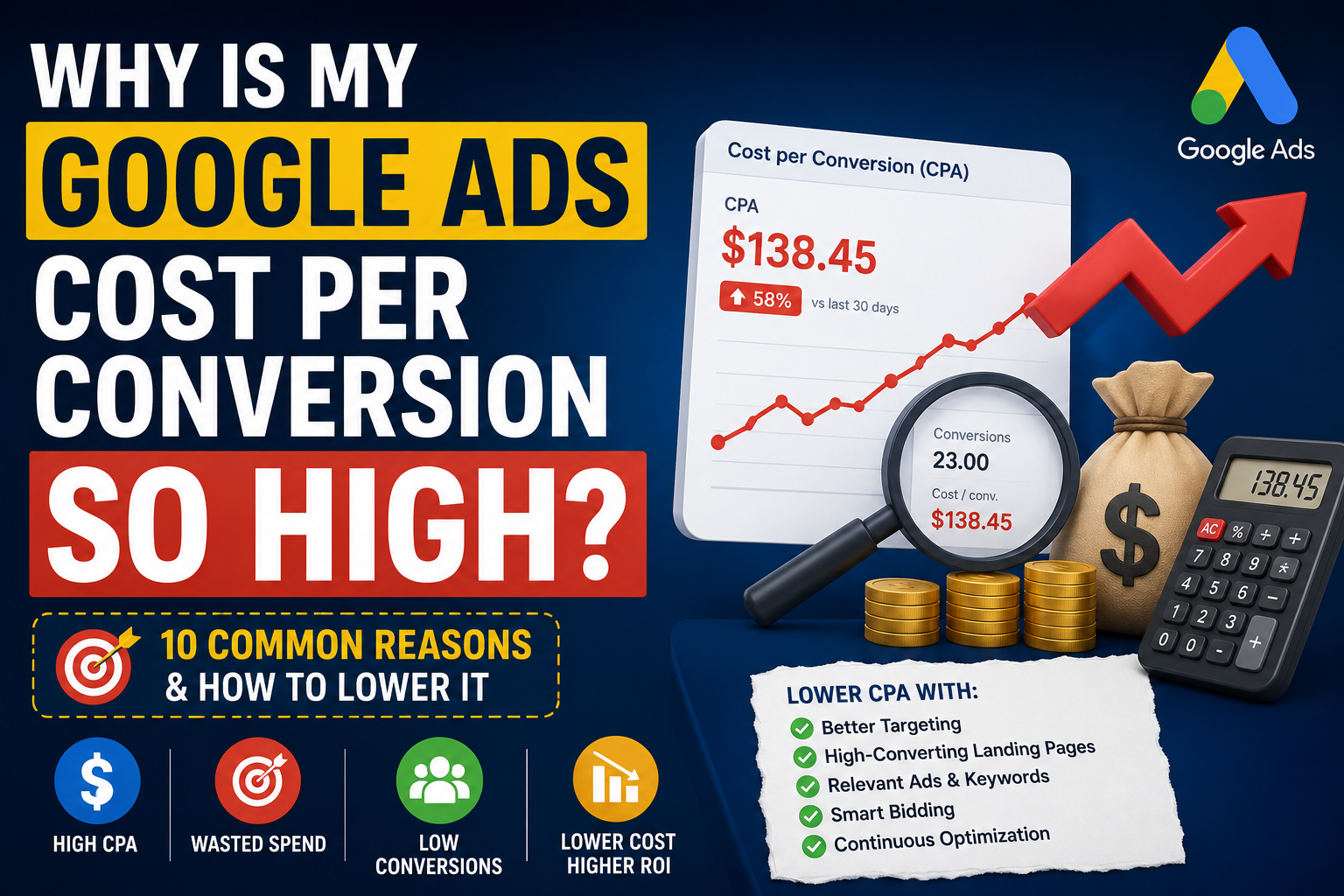
Google Ads Cost Per Conversion High? If your campaigns are generating leads but your Cost Per Conversion (CPA) keeps increasing, you’re not alone. Many advertisers struggle with high CPA because of poor keyword targeting, weak landing pages, or inefficient campaign optimization.
A high CPA means you’re spending more money to acquire each customer. While this isn’t always a problem—especially if customer lifetime value is high—it often signals inefficiencies within your campaigns.
The good news is that most high CPA issues can be identified and corrected. Whether the problem lies in your keywords, bidding strategy, landing pages, audience targeting, or conversion tracking, improving these areas can help reduce your acquisition costs without sacrificing growth.
In this guide, we’ll explore the most common reasons why your Google Ads Cost Per Conversion is high and the practical steps you can take to improve campaign profitability.
1. You’re Targeting the Wrong Keywords
Not all keywords generate customers.
Informational keywords often produce clicks without conversions, while commercial-intent keywords typically deliver higher-quality traffic.
How to fix it
- Focus on high-intent keywords.
- Review your Search Terms Report regularly.
- Add negative keywords.
- Pause keywords that consistently fail to convert.
2. Your Landing Page Isn’t Converting
Even perfectly targeted traffic won’t convert if your landing page doesn’t build trust or guide visitors toward taking action.
Common issues include:
- Slow loading speed
- Weak headline
- Poor mobile experience
- Confusing layout
- No clear call-to-action
- Lack of trust signals
Improving your landing page often has a greater impact than increasing your ad budget.
3. You’re Paying Too Much Per Click
Higher CPC usually leads to a higher CPA unless conversion rates improve.
Review whether your bids are appropriate and look for opportunities to improve Quality Score rather than simply increasing budgets.
4. Your Conversion Tracking Isn’t Accurate
Incorrect conversion tracking can make your CPA appear much higher—or lower—than it actually is.
Check that:
- Primary conversions are correctly configured.
- Duplicate conversions aren’t being counted.
- Test conversions are excluded.
- Tracking is firing correctly across devices.
Reliable data is essential for making informed optimization decisions.
5. Your Audience Targeting Is Too Broad
Broad targeting often attracts visitors who aren’t ready to buy.
Review:
- Geographic locations
- Device performance
- Audience segments
- Demographics
- Ad schedules
Focusing on your highest-performing audiences can significantly reduce CPA.
6. Your Ads Attract the Wrong Visitors
A compelling ad should attract the right customers—not simply more clicks.
Avoid misleading headlines or offers that create curiosity but don’t match your landing page.
Better alignment between ads and landing pages generally leads to higher conversion rates and lower CPA.
7. You’re Optimizing for Clicks Instead of Conversions
Choosing the wrong bidding strategy can increase acquisition costs.
If your goal is lead generation or sales, bidding strategies focused on conversions often outperform those designed purely to maximize clicks.
Review whether your campaign objective aligns with your business goals.
8. You’re Not Excluding Poor-Performing Traffic
Many accounts continue spending money on:
- Non-converting keywords
- Low-performing devices
- Weak locations
- Poor audience segments
Regular optimization helps redirect budget toward higher-performing traffic.
9. Your Competition Has Become More Aggressive
Higher competition can increase both CPC and CPA.
Rather than simply increasing bids, focus on improving:
- Ad relevance
- Landing page quality
- Quality Score
- Unique offers
- Conversion rate
Better campaigns often outperform larger budgets.
10. You’re Measuring CPA Without Looking at Profitability
A lower CPA isn’t always better.
For example:
- A $40 CPA generating a $2,000 client may be excellent.
- A $10 CPA generating an unqualified lead may not be profitable.
Always evaluate CPA alongside:
- Lead quality
- Revenue
- Customer Lifetime Value (LTV)
- Return on Ad Spend (ROAS)
Your objective isn’t simply reducing CPA—it’s maximizing profitable growth.
Final Thoughts
A high Google Ads Cost Per Conversion doesn’t necessarily mean your campaigns are failing. More often, it highlights opportunities to improve keyword targeting, landing pages, audience selection, bidding strategies, and overall campaign optimization.
Reducing CPA is rarely about one single change. Small improvements across multiple areas often produce the biggest long-term gains.
If you’re unsure why your acquisition costs remain high, a professional Google Ads Audit can identify wasted spend, uncover hidden opportunities, and help you build campaigns that generate more qualified leads at a lower cost.
Frequently Asked Questions
What is Cost Per Conversion in Google Ads?
Cost Per Conversion (CPA) measures how much you spend, on average, to generate one conversion, such as a lead, purchase, or enquiry.
Why is my Google Ads CPA increasing?
Higher competition, poor keyword targeting, weak landing pages, inaccurate conversion tracking, and declining conversion rates are some of the most common causes.
How can I reduce my Cost Per Conversion?
Improve keyword quality, optimize landing pages, strengthen ad relevance, refine audience targeting, and regularly review campaign performance.
Is a high CPA always bad?
Not necessarily. If your customers generate significant long-term revenue, a higher CPA may still produce an excellent return on investment.