

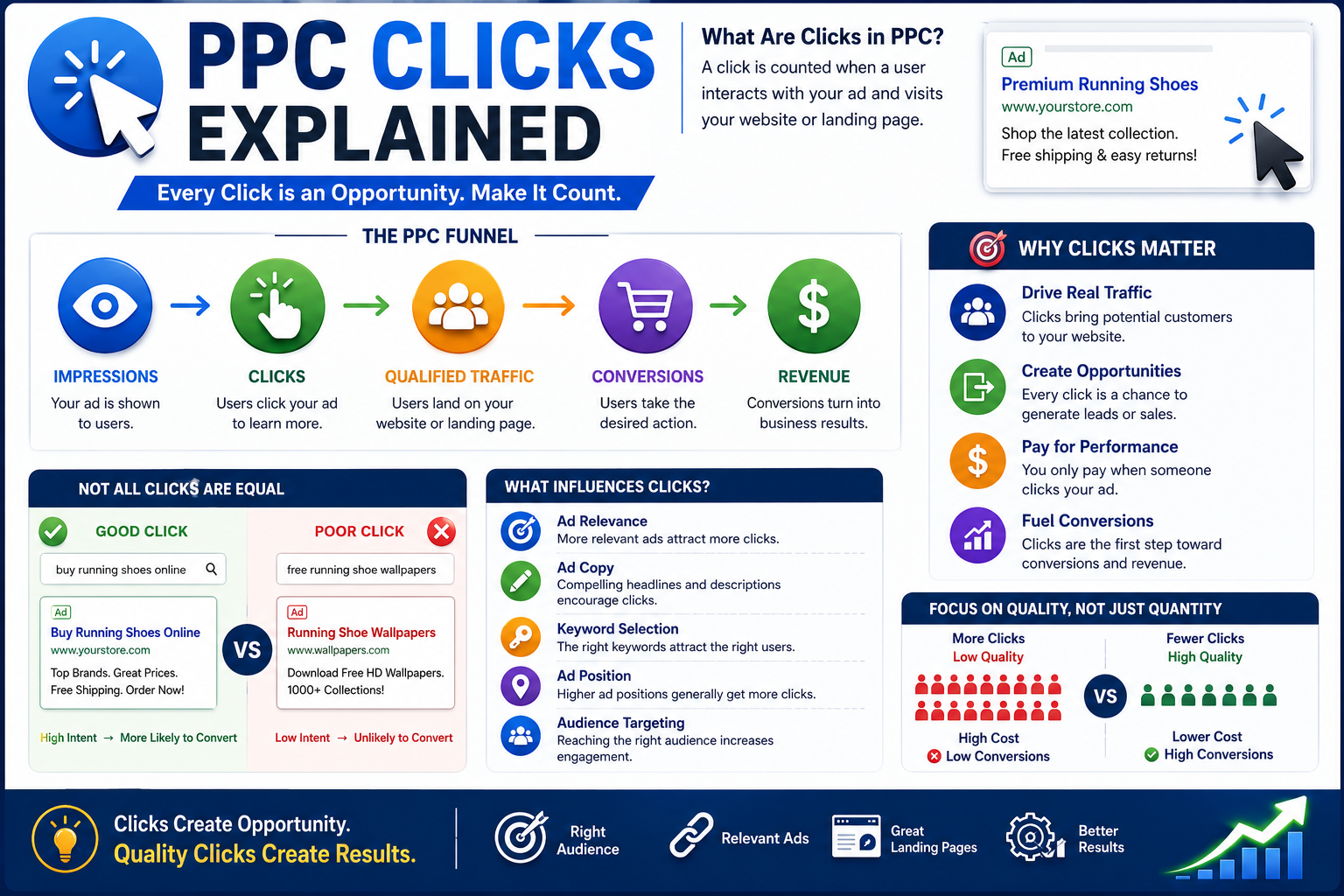
What Are Clicks in PPC?
Clicks are one of the most important metrics in Pay-Per-Click (PPC) advertising because they represent the moment a user interacts with your ad.
In simple terms, a click occurs when someone sees your advertisement and decides to take action by clicking on it.
Whether you’re running Google Ads, Microsoft Ads, Facebook Ads, or LinkedIn Ads, clicks are often the first step toward generating leads, sales, and revenue.
While impressions tell you how many people saw your ad, clicks tell you how many people were interested enough to engage with it.
Why Clicks Matter in PPC
Every PPC campaign is designed to achieve a business goal.
That goal might be:
- Generating leads
- Increasing online sales
- Driving website traffic
- Growing brand awareness
- Promoting a service
Clicks are what move users from seeing your ad to visiting your website or landing page.
Without clicks, there is no opportunity for users to learn more about your business, submit a lead form, make a purchase, or complete any other valuable action.
The PPC Funnel
Impressions → Clicks → Conversions → Revenue
Clicks sit at the center of the PPC funnel.
They bridge the gap between visibility and business results.
What Happens After a Click?
When a user clicks on your ad, they are directed to a specific destination.
This could be:
- A website page
- A landing page
- An ecommerce product page
- A lead generation form
- A mobile app download page
The goal is to provide a seamless experience that encourages the visitor to take the next step.
A click creates an opportunity, but what happens after the click often determines campaign success.
Not All Clicks Are Equal
One of the biggest mistakes advertisers make is assuming every click has the same value.
In reality, some clicks are significantly more valuable than others.
Consider two users:
User A
Searches for:
“buy running shoes online”
User B
Searches for:
“free running shoe images”
Both users may click an ad.
However, User A is far more likely to become a customer.
This is why successful PPC campaigns focus on attracting qualified clicks rather than simply increasing click volume.
Why Advertisers Pay for Clicks
Google Ads operates primarily on a Pay-Per-Click model.
This means advertisers pay when someone clicks on their ad.
Because every click has a cost attached to it, advertisers must ensure those clicks have the potential to generate value.
The objective isn’t to buy traffic.
The objective is to acquire potential customers.
A campaign generating thousands of low-quality clicks may perform worse than a campaign generating a smaller number of highly qualified clicks.
Factors That Influence Click Volume
Several factors affect how many clicks your ads receive.
🎯 Ad Relevance
The more relevant your ad is to a user’s search query, the more likely they are to click.
✍️ Ad Copy
Strong headlines and compelling descriptions encourage engagement.
🔑 Keyword Selection
Choosing the right keywords helps attract users who are actively searching for your products or services.
📍 Ad Position
Ads appearing in prominent positions generally receive more clicks.
👥 Audience Targeting
Showing ads to the right audience increases the likelihood of engagement.
More Clicks Don’t Always Mean Better Results
Many advertisers focus heavily on increasing click volume.
However, more clicks do not always translate into better performance.
Consider these two campaigns:
Campaign A
- 1,000 Clicks
- 5 Leads
Campaign B
- 300 Clicks
- 25 Leads
Campaign B clearly delivers more value despite generating fewer clicks.
This is because the quality of traffic matters more than the quantity.
The goal should never be to maximize clicks at any cost.
The goal should be to attract visitors who are likely to convert.
Why Click Quality Matters
Quality clicks often lead to:
✅ Better conversion rates
✅ More qualified leads
✅ Lower acquisition costs
✅ Higher return on ad spend (ROAS)
✅ Better overall campaign performance
Experienced PPC managers focus on attracting users who have genuine interest and buying intent.
This approach typically produces stronger long-term results than simply chasing traffic volume.
Common Click Mistakes
Many advertisers optimize for the wrong objectives.
Common mistakes include:
❌ Focusing only on click volume
❌ Targeting overly broad keywords
❌ Ignoring user intent
❌ Driving traffic to poor landing pages
❌ Measuring success only by traffic
Successful campaigns focus on business outcomes rather than vanity metrics.
Clicks Are Only Part of the Story
While clicks are an important PPC metric, they should never be viewed in isolation.
A campaign may generate thousands of clicks, but that doesn’t automatically mean it’s successful.
Advertisers should also evaluate:
- Traffic quality
- Conversion rate
- Cost per acquisition (CPA)
- Return on ad spend (ROAS)
- Revenue generated
The most successful PPC campaigns focus on attracting the right visitors rather than simply maximizing click volume.
In the next part of this series, we’ll explore how marketers measure the relationship between impressions and clicks, and why that metric is one of the most important indicators of ad relevance and performance.
Final Thoughts
Clicks are one of the most important metrics in PPC advertising because they represent user engagement and the opportunity to generate conversions.
However, successful PPC campaigns don’t focus on getting more clicks.
They focus on getting better clicks.
Remember:
**Impressions create visibility. Clicks create opportunity. Conversions create business results.