

💵 What Is Average CPC?
Average CPC stands for Average Cost-Per-Click.
It measures the average amount an advertiser pays each time someone clicks on their advertisement.
Average CPC is one of the most commonly used PPC metrics because it helps advertisers understand the cost of generating website traffic through paid advertising.
Simply put:
Average CPC shows how much a click costs on average.
How Is Average CPC Calculated?
Google calculates Average CPC using a simple formula:
Average CPC Formula
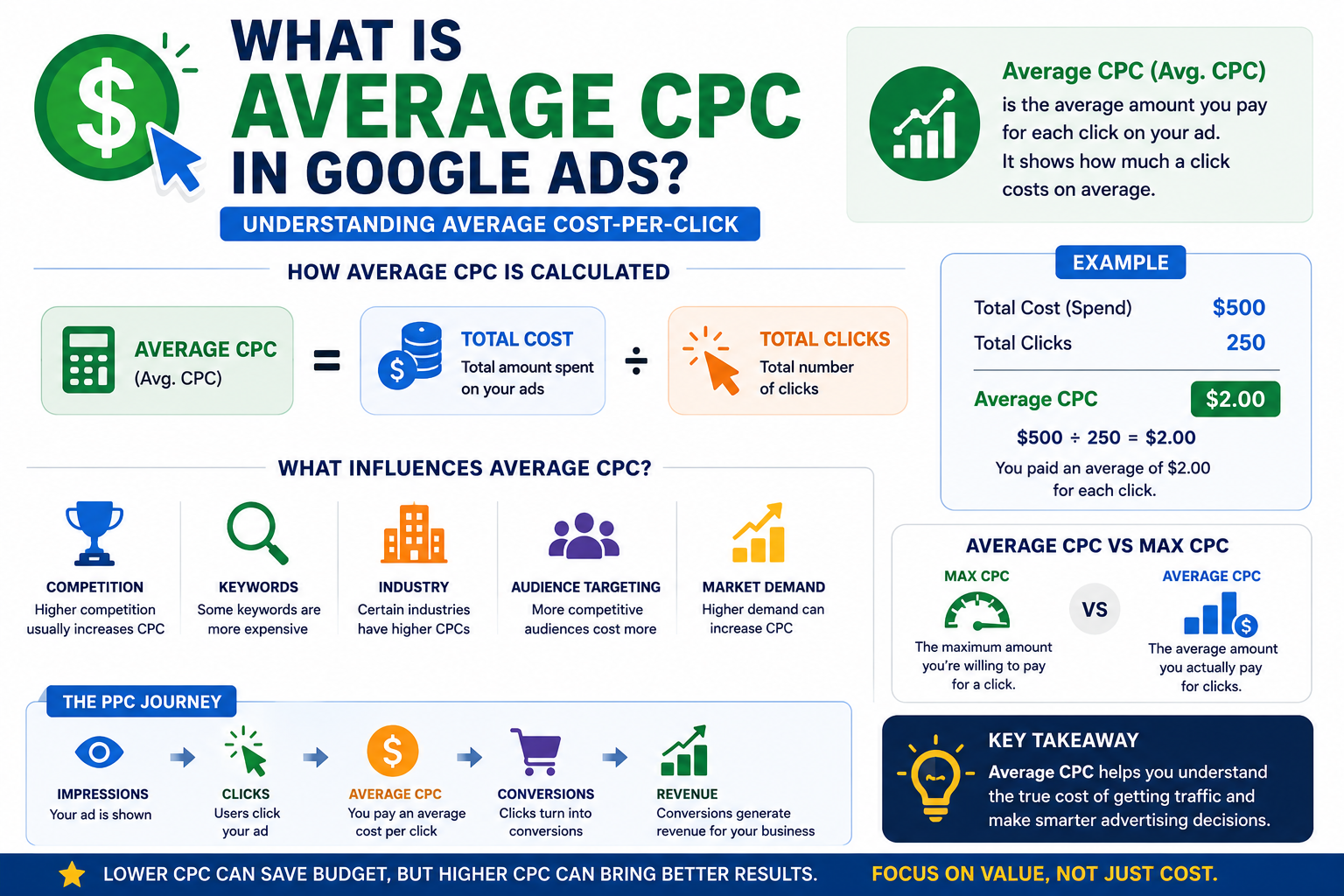
Average CPC = Total Cost ÷ Total Clicks
For example:
- Total Ad Spend = $500
- Total Clicks = 250
Average CPC = $500 ÷ 250
Average CPC = $2.00
This means you paid an average of $2 for each click.
Understanding Average CPC With an Example
Imagine your campaign generated:
- 1,000 Clicks
- Total Spend: $2,500
Average CPC:
$2,500 ÷ 1,000 = $2.50
Your Average CPC is $2.50.
Some clicks may have cost less, while others may have cost more, but the average cost per click is $2.50.
Why Average CPC Matters
Average CPC helps advertisers understand the cost of acquiring traffic.
It provides insight into:
✅ Advertising Costs
✅ Budget Efficiency
✅ Campaign Competitiveness
✅ Traffic Acquisition Costs
The lower the Average CPC, the more traffic an advertiser may be able to generate within the same budget.
Average CPC vs Max CPC
Many advertisers confuse these metrics.
Max CPC
The maximum amount you’re willing to pay for a click.
Average CPC
The average amount you actually pay for clicks.
Example:
- Max CPC = $5.00
- Average CPC = $2.80
Google may never charge the full Max CPC amount.
As a result, Average CPC is often lower than Max CPC.
What Influences Average CPC?
Several factors can impact Average CPC.
Competition
Highly competitive industries often experience higher click costs.
Keywords
Some keywords are naturally more expensive than others.
Industry
Industries such as legal, insurance, finance, and SaaS often have higher CPCs.
Audience Targeting
More competitive audiences can increase click costs.
Market Demand
Higher advertiser demand often leads to higher CPCs.
Is a Low Average CPC Always Better?
Not necessarily.
A lower CPC can reduce advertising costs, but cheap clicks do not always produce better business results.
For example:
Campaign A
Average CPC = $1
Generates low-quality traffic.
Campaign B
Average CPC = $5
Generates high-quality leads and sales.
In many cases, paying more for valuable traffic can produce better results.
Average CPC in the PPC Funnel
The PPC journey can be viewed as:
Impressions → Clicks → Average CPC → Conversions → Revenue
Average CPC helps advertisers understand how much they are investing to generate traffic before conversions occur.
Frequently Asked Questions
What does Average CPC mean?
Average CPC is the average amount paid for each click on an advertisement.
How is Average CPC calculated?
Average CPC is calculated by dividing total advertising spend by total clicks.
Is Average CPC the same as Max CPC?
No.
Max CPC is your bidding limit, while Average CPC is the average amount you actually pay.
Why is Average CPC important?
It helps advertisers understand traffic acquisition costs and advertising efficiency.
Can Average CPC change over time?
Yes.
Competition, market conditions, keyword demand, and campaign performance can all affect Average CPC.
Final Thoughts
Average CPC is one of the most important PPC metrics because it shows the average cost of generating traffic through paid advertising.
Understanding Average CPC helps advertisers better understand advertising costs, budgeting, and campaign performance.
Remember:
Max CPC is what you’re willing to pay. Average CPC is what you actually pay on average.