

If you’ve spent any time managing Google Ads campaigns, you’ve probably heard the term Quality Score.
Many advertisers focus heavily on bids and budgets, assuming that spending more money is the key to improving results. However, Google also evaluates the quality and relevance of your ads, keywords, and landing pages.
This evaluation is known as Quality Score.
Understanding Quality Score can help advertisers improve campaign performance, lower advertising costs, increase click-through rates, and generate better results without necessarily increasing budgets.
In this guide, you’ll learn what Quality Score is, how Google calculates it, why it matters, and how to improve it.
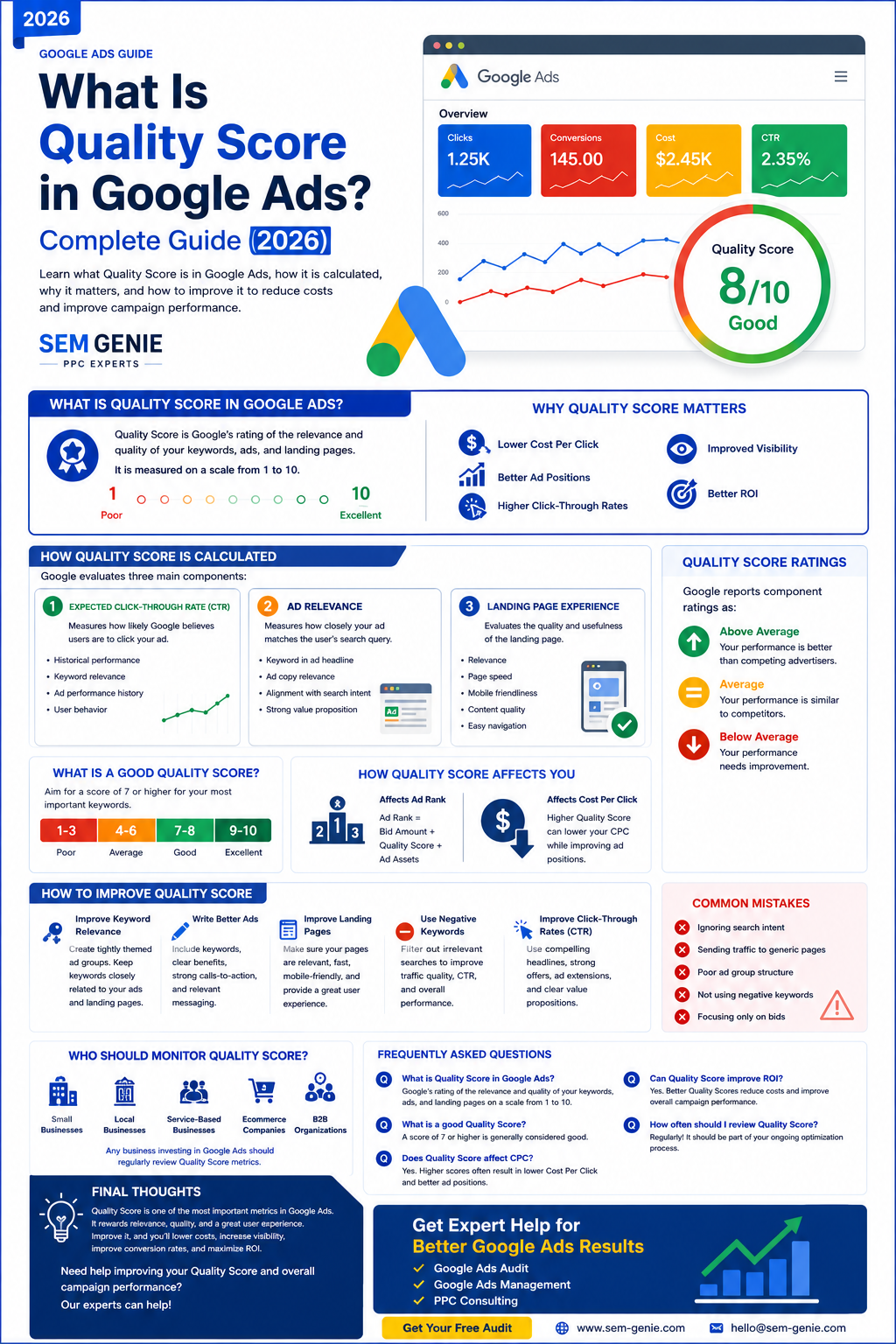
What Is Quality Score in Google Ads?
Quality Score is Google’s rating of the relevance and quality of your keywords, ads, and landing pages.
It is measured on a scale from: 1 to 10
Where: 1 = Poor and 10 = Excellent
Google uses Quality Score as an indicator of how useful and relevant your advertising experience is for users.
A higher Quality Score often leads to:
- Lower costs
- Better ad positions
- Higher click-through rates
- Improved campaign efficiency
Quality Score is available at the keyword level within Google Ads.
Why Does Quality Score Matter?
Many advertisers assume that the highest bidder always wins the top position.
That’s not entirely true.
Google wants users to see relevant ads that provide a good experience.
As a result, Google rewards advertisers who create highly relevant campaigns.
Benefits of a higher Quality Score include:
- Lower Cost Per Click (CPC)
- Better Ad Rank
- Improved Visibility
- Higher Click-Through Rates
- Better Return on Investment (ROI)
A strong Quality Score can often outperform competitors with larger budgets.
How Quality Score Is Calculated
Google evaluates three primary components.
Expected Click-Through Rate (CTR)
Expected CTR measures how likely Google believes users are to click your ad.
Factors influencing Expected CTR include:
- Historical performance
- Keyword relevance
- Ad performance history
- User behavior
Ads that consistently attract clicks generally receive better scores.
Ad Relevance
Ad Relevance measures how closely your ad matches the user’s search query.
For example:
Search Query: Google Ads Consultant
Relevant Ad: Google Ads Consultant Services, Expert PPC Consulting & Optimization
Less Relevant Ad: Digital Marketing Services, SEO, Social Media & Web Design
The first ad aligns much better with the search intent.
Landing Page Experience
Google also evaluates the page users visit after clicking your ad.
Factors include:
- Relevance
- User experience
- Mobile friendliness
- Page speed
- Content quality
- Navigation
Landing pages that closely match user intent generally achieve higher scores.
Understanding Quality Score Ratings
Google reports component ratings as:
Above Average
Your performance is better than competing advertisers.
Average
Your performance is similar to competitors.
Below Average
Your performance needs improvement.
Even small improvements in these areas can increase overall Quality Score.
What Is a Good Quality Score?
Generally:
| Score | Meaning |
|---|---|
| 1-3 | Poor |
| 4-6 | Average |
| 7-8 | Good |
| 9-10 | Excellent |
Most advertisers should aim for: 7+ for their most important keywords.
Not every keyword needs a perfect score.
Focus on keywords that generate leads, sales, and revenue.
How Quality Score Affects Ad Rank
Quality Score directly influences Ad Rank.
Ad Rank determines where your ad appears on the search results page.
Google considers: Bid Amount + Quality Score + Ad Assets
A competitor with a lower bid can sometimes outrank another advertiser with a higher bid if their Quality Score is significantly better.
This is one reason why campaign quality matters.
How Quality Score Affects Cost Per Click
Higher Quality Scores often reduce advertising costs.
For example:
Advertiser A: Quality Score: 4
Advertiser B: Quality Score: 8
Advertiser B may achieve similar or better positions while paying less per click.
Over thousands of clicks, the savings can be substantial.
How to Improve Quality Score
Improve Keyword Relevance
Create tightly themed ad groups.
Avoid placing unrelated keywords into the same ad group.
The more closely keywords align with ads, the better.
Write Better Ads
Ensure your ads include:
- Primary keywords
- Clear benefits
- Strong calls-to-action
- Relevant messaging
The goal is to improve relevance and click-through rates.
Improve Landing Pages
Landing pages should match the searcher’s intent.
Focus on:
- Fast loading speed
- Mobile responsiveness
- Clear messaging
- Strong calls-to-action
- Relevant content
A poor landing page can negatively impact campaign performance.
Use Negative Keywords
Negative keywords help prevent ads from appearing for irrelevant searches.
Benefits include:
- Better traffic quality
- Higher conversion rates
- Improved CTR
- Reduced wasted spend
Read our guide on negative keywords to learn more about filtering unwanted traffic.
Improve Click-Through Rates
Higher CTR often signals relevance.
Ways to improve CTR include:
- Better headlines
- Stronger offers
- Ad extensions
- Clear value propositions
Improving CTR often improves Quality Score over time.
Common Quality Score Mistakes
Ignoring Search Intent
Keywords, ads, and landing pages should all align with user intent.
Sending Traffic to Generic Pages
Many advertisers send all traffic to the homepage.
Dedicated landing pages usually perform better.
Poor Ad Group Structure
Large ad groups with unrelated keywords reduce relevance.
Not Using Negative Keywords
Irrelevant traffic can hurt CTR and overall performance.
Focusing Only on Bids
Increasing bids without improving quality often leads to higher costs rather than better performance.
Benefits of Improving Quality Score
Businesses that improve Quality Score often experience:
- Lower CPC
- Better Ad Rank
- Higher CTR
- Better Conversion Rates
- Reduced Wasted Spend
- Improved ROI
For many advertisers, Quality Score improvements represent one of the easiest ways to improve profitability.
Who Should Monitor Quality Score?
Quality Score is important for:
Small Businesses
Maximize limited advertising budgets.
Local Businesses
Improve visibility within target markets.
Service-Based Businesses
Generate higher-quality leads.
Ecommerce Companies
Reduce costs and improve return on ad spend.
B2B Organizations
Increase lead quality and campaign efficiency.
Any business investing in Google Ads should regularly review Quality Score metrics.
Frequently Asked Questions
What is Quality Score in Google Ads?
Quality Score is Google’s rating of the relevance and quality of your keywords, ads, and landing pages on a scale from 1 to 10.
What is a good Quality Score?
A Quality Score of 7 or higher is generally considered good.
Does Quality Score affect CPC?
Yes. Higher Quality Scores often result in lower Cost Per Click and better ad positions.
Can Quality Score improve ROI?
Yes. Better Quality Scores can reduce costs and improve overall campaign performance.
How often should I review Quality Score?
Most advertisers should review Quality Score regularly as part of ongoing campaign optimization.
Final Thoughts
Quality Score is one of the most important metrics in Google Ads.
While bids and budgets matter, Google rewards advertisers who create relevant ads, target the right keywords, and provide high-quality landing page experiences.
Improving Quality Score can help lower costs, increase visibility, improve conversion rates, and maximize return on investment.
If your campaigns are struggling to generate results, reviewing Quality Score is often one of the best places to start.
A professional Google Ads audit can also help identify Quality Score issues, keyword opportunities, landing page improvements, and optimization strategies that drive better results.