

Introduction
Google Ads can be one of the most effective ways to generate leads, sales, and business growth. However, even well-intentioned campaigns can underperform when accounts are not reviewed regularly.
Many businesses continue increasing budgets while overlooking issues that reduce efficiency and waste advertising spend.
A Google Ads audit helps identify performance problems, uncover missed opportunities, and improve return on investment.
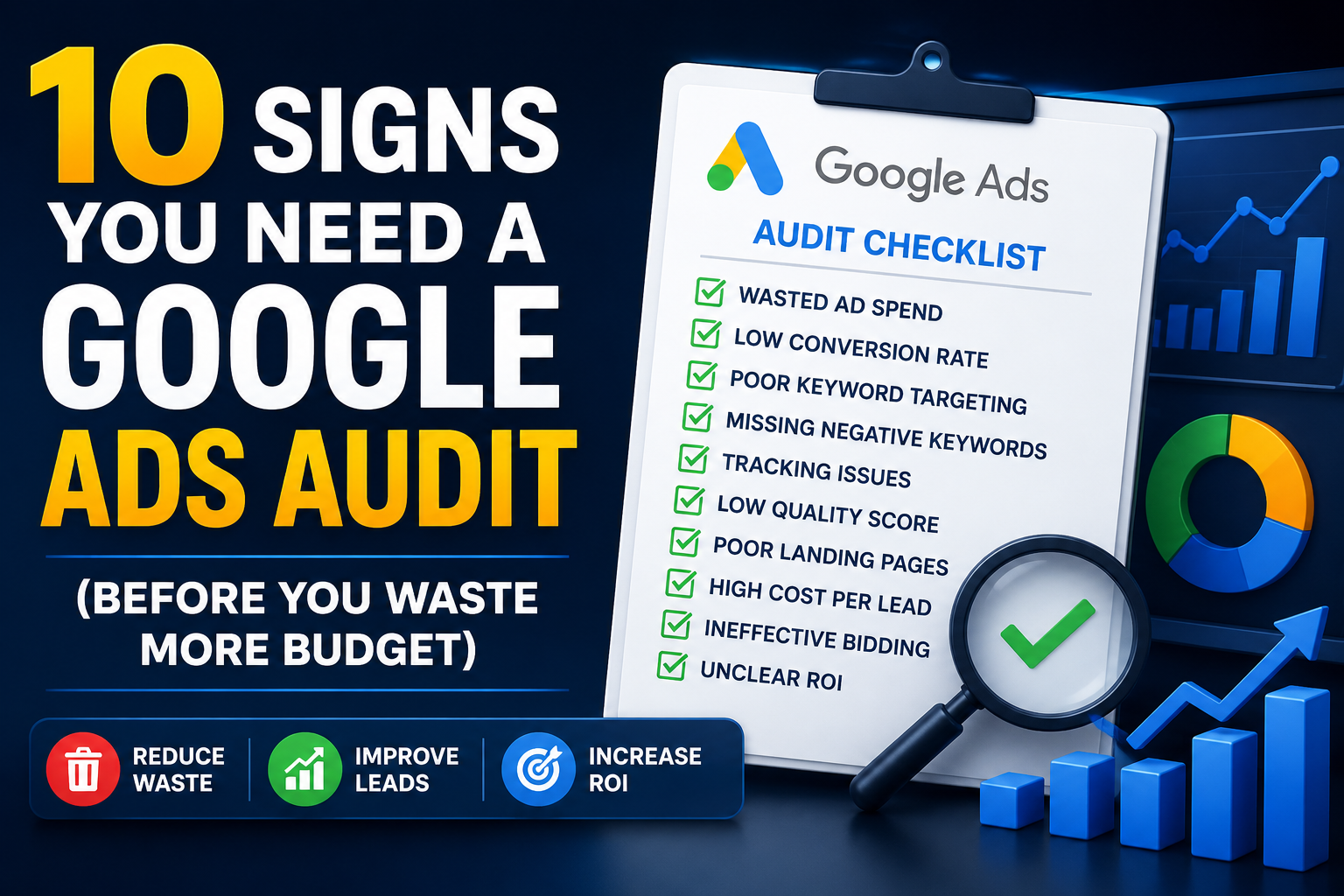
In this guide, we’ll cover 10 common signs that indicate it’s time for a Google Ads audit.
What Is a Google Ads Audit?
A Google Ads audit is a detailed review of your advertising account designed to identify issues affecting performance.
An audit typically reviews:
- Campaign structure
- Keywords
- Search terms
- Negative keywords
- Ad copy
- Conversion tracking
- Landing pages
- Bidding strategies
- Budget allocation
The goal is to identify opportunities to improve campaign performance and maximize return on investment.
1. You’re Spending Money but Not Generating Leads
One of the most obvious warning signs is spending money without seeing meaningful business results.
Many advertisers focus on clicks and traffic while overlooking actual conversions.
If your campaigns generate visits but not leads or sales, a Google Ads audit can help identify the underlying cause.
Possible issues include:
- Poor targeting
- Weak landing pages
- Tracking problems
- Low-quality traffic
2. Your Cost Per Lead Keeps Increasing
If your Cost Per Acquisition (CPA) continues to rise, your campaigns may be losing efficiency.
Common causes include:
- Increased competition
- Poor keyword targeting
- Weak conversion rates
- Irrelevant traffic
An audit can identify areas where costs can be reduced without sacrificing lead volume.
3. You’re Getting Clicks but No Conversions
Clicks alone don’t generate revenue.
If users are clicking ads but failing to complete desired actions, there may be problems with:
- Landing page experience
- Offer quality
- Conversion tracking
- Audience targeting
This is one of the most common reasons businesses request a Google Ads audit.
4. Conversion Tracking Is Missing or Inaccurate
Without accurate conversion tracking, optimization becomes guesswork.
Many advertisers discover:
- Missing conversions
- Duplicate conversions
- Incorrect attribution
- Untracked phone calls
- Broken form tracking
A Google Ads audit should always include a conversion tracking review.
5. Your Search Terms Look Irrelevant
Google Ads can sometimes match ads to searches that are not relevant to your business.
Examples include:
- Job seekers
- Students
- Free service searches
- Research-related queries
Reviewing Search Terms Reports often reveals wasted spend that can be eliminated through better keyword targeting and negative keywords.
6. You Have Few or No Negative Keywords
Negative keywords are one of the most powerful optimization tools in Google Ads.
Without negative keywords, your campaigns may appear for irrelevant searches.
This often leads to:
- Wasted budget
- Lower conversion rates
- Higher CPA
A Google Ads audit can identify opportunities to expand your negative keyword list.
7. Quality Scores Are Low
Quality Score affects:
- Ad relevance
- Expected CTR
- Landing page experience
Low Quality Scores can increase costs and reduce ad visibility.
An audit can identify areas where Quality Score improvements may increase efficiency.
8. Campaigns Haven’t Been Reviewed Recently
Google Ads is constantly evolving.
New competitors, changing search behavior, and platform updates can affect performance over time.
If your campaigns haven’t been reviewed in several months, there is a strong chance opportunities are being missed.
Regular audits help keep campaigns aligned with current best practices.
9. Competitors Seem to Be Outperforming You
If competitors consistently appear above your ads or dominate search results, it may indicate issues such as:
- Poor Ad Rank
- Weak bidding strategy
- Low Quality Scores
- Limited impression share
An audit can uncover the factors affecting competitiveness.
10. You Don’t Know What’s Working
Many business owners receive reports full of data but still don’t know:
- Which keywords generate leads
- Which campaigns are profitable
- Which ads perform best
- Which audiences convert
A proper audit helps transform data into actionable insights.
What a Professional Google Ads Audit Should Include
A comprehensive audit should evaluate:
Campaign Structure
Review campaign organization and targeting.
Keyword Strategy
Identify opportunities to improve keyword targeting.
Search Terms Analysis
Review actual search queries triggering ads.
Negative Keywords
Identify wasted spend and irrelevant traffic.
Conversion Tracking
Verify tracking accuracy.
Landing Pages
Evaluate conversion opportunities.
Bidding Strategies
Review bidding methods and budget allocation.
Performance Metrics
Analyze:
- CTR
- Conversion Rate
- CPA
- ROAS
- Impression Share
Benefits of a Google Ads Audit
Businesses often experience:
- Lower Cost Per Lead
- Better Lead Quality
- Improved Conversion Rates
- Reduced Wasted Spend
- Better Budget Allocation
- Increased Return on Investment
Even high-performing accounts can benefit from regular audits.
Frequently Asked Questions
How often should a Google Ads audit be performed?
Most businesses should perform a Google Ads audit at least every 6 to 12 months.
Can a Google Ads audit reduce wasted spend?
Yes. Audits frequently identify irrelevant traffic, inefficient keywords, and tracking issues.
What is reviewed during a Google Ads audit?
Campaign structure, keywords, search terms, conversion tracking, bidding strategies, landing pages, and performance metrics.
Is a Google Ads audit worth it?
For most businesses, yes. Even small improvements can have a significant impact on lead quality and advertising ROI.
Final Thoughts
Google Ads campaigns can gradually lose efficiency over time without regular review and optimization.
If you’re experiencing rising costs, low conversion rates, poor lead quality, or uncertainty about performance, a Google Ads audit can help identify opportunities for improvement.
Whether you’re managing campaigns internally, working with an agency, or using a consultant, regular audits help ensure your advertising budget is being used effectively.
If you’re unsure whether your account is performing as well as it should, consider requesting a professional Google Ads audit or a free Google Ads consultation to uncover hidden opportunities for growth.