

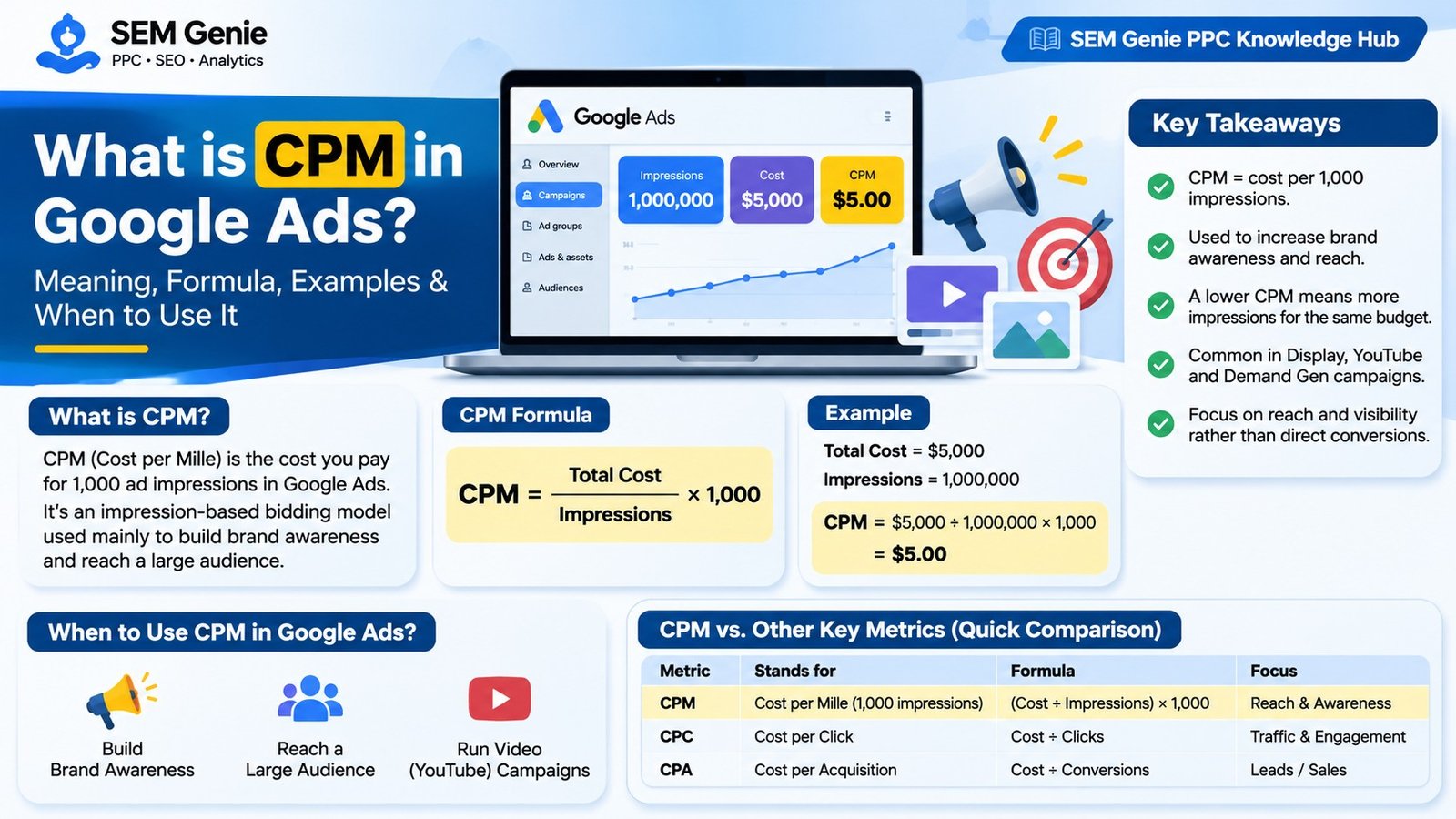
CPM in Google Ads means cost per thousand impressions. It tells you how much an advertiser pays, or the average cost incurred, for every 1,000 times an ad is shown. CPM is particularly useful when the objective is to build awareness, reach a defined audience or deliver video and display exposure. It does not, by itself, tell you whether those impressions generated clicks, leads or sales.
In this guide, I explain how CPM works, how to calculate it, how it differs from CPC and when it is useful for evaluating paid advertising performance.
What Does CPM Mean in Google Ads?
CPM stands for cost per mille, with “mille” meaning one thousand. In advertising, it is the cost associated with 1,000 ad impressions. An impression is recorded when an ad is served, subject to the measurement rules of the campaign and advertising platform.
For example, if a campaign spends $100 and records 20,000 impressions, its average CPM is $5. In other words, the campaign cost $5 for every 1,000 impressions delivered.
How to Calculate CPM
Use this formula:
CPM = (Total advertising cost ÷ Total impressions) × 1,000
Example: A campaign spends $750 and receives 150,000 impressions.
($750 ÷ 150,000) × 1,000 = $5 CPM
The campaign’s average cost was $5 for every 1,000 impressions. You can use the same calculation with your account currency and reporting period.
Average CPM vs Target CPM
These terms are related, but they do not mean the same thing:
- Average CPM: A performance metric calculated from campaign cost and impressions. It describes the average cost of 1,000 impressions delivered.
- Target CPM (tCPM): A bidding approach in eligible video campaigns where you set the average amount you are willing to pay per 1,000 impressions. Google Ads optimises bids with the aim of achieving the target on average; individual impression costs can vary.
- Viewable CPM (vCPM): A pricing or bidding metric based on 1,000 viewable impressions, rather than simply 1,000 served impressions. Viewability is determined using the platform’s measurement criteria.
Always check which CPM column or bidding strategy you are reviewing. Average CPM, target CPM and viewable CPM answer different questions.
When Is CPM Used in Google Ads?
CPM is most relevant when campaign success depends on exposure and reach rather than only on immediate clicks. Depending on campaign type, inventory and bidding options available in the account, CPM-based approaches can be used for display and video advertising, including YouTube campaigns.
Search campaigns are more commonly evaluated through click-focused measures such as average CPC and CTR. If your objective is to capture existing search demand, CPM alone is unlikely to tell you whether the campaign is commercially effective.
CPM vs CPC: What Is the Difference?
| Metric | Meaning | Best used to understand |
|---|---|---|
| CPM | Cost per 1,000 impressions | Cost of delivering ad exposure |
| CPC | Cost per click | Cost of generating clicks |
| CTR | Clicks divided by impressions | How often impressions lead to clicks |
CPM and CPC measure different stages of advertising delivery. A low CPM may help a campaign reach more people for the same budget, but it does not guarantee meaningful engagement. A higher CPM may still be justified if the campaign reaches a more relevant or valuable audience.
For related explanations, see the SEM Genie guides to impressions, clicks, CTR and average CPC.
What Is a Good CPM in Google Ads?
There is no single CPM that is good for every advertiser. CPM varies with audience size, location, industry, competition, placement, seasonality, creative format, campaign objective and inventory quality. A CPM that is efficient for a broad awareness campaign may not be comparable with one for a narrow, high-value audience.
Instead of judging CPM against a universal benchmark, compare it with:
- Your own historical CPM for similar campaigns and audiences.
- Reach and frequency, to understand how broadly and how often people are exposed to the ads.
- CTR, video engagement or other relevant interaction measures.
- Website visits, conversions and conversion value where those outcomes are part of the campaign objective.
- Audience and placement quality, not just the cheapest available inventory.
How to Improve CPM Efficiency
The goal should not automatically be to get the lowest CPM. Focus on the cost of reaching the right audience and whether that exposure contributes to the campaign objective. Practical checks include:
- Review audience targeting: Check whether targeting is unnecessarily restrictive or excludes relevant users.
- Check placements and inventory: Review where ads appear and whether those placements suit the brand and campaign objective.
- Monitor frequency: Very high frequency can mean the same audience is seeing the ad repeatedly. Consider whether reach or creative rotation needs attention.
- Test creative formats: Compare different messages, images and video formats while keeping the audience and objective in mind.
- Compare like with like: Evaluate campaigns over comparable dates, geographies, audiences and formats.
- Connect exposure to outcomes: Use appropriate conversion tracking and assess downstream results where measurable.
CPM and the Metrics You Should Review Alongside It
CPM is more useful when it is read alongside other metrics. Impressions show delivery volume; reach and frequency help describe audience exposure; CTR shows the proportion of impressions that generated clicks; and conversions or conversion value help connect advertising activity to business outcomes. For revenue-focused campaigns, review ROAS as well, where conversion values are measured reliably.
For example, a campaign may have a low CPM but weak engagement and no meaningful conversions. Another campaign may have a higher CPM but reach a more relevant audience and contribute more valuable outcomes. The right interpretation depends on the objective, not the CPM number in isolation.
Frequently Asked Questions
What does CPM stand for?
CPM stands for cost per mille, or cost per 1,000 impressions.
How do I calculate CPM in Google Ads?
Divide the campaign cost by the number of impressions and multiply the result by 1,000.
Is a lower CPM always better?
No. A lower CPM can make exposure less expensive, but it does not guarantee that the audience is relevant or that the campaign will generate useful engagement or conversions.
Is CPM used for Google Search campaigns?
Search advertising is generally click-focused and commonly evaluated using CPC and CTR. CPM is more relevant to display and video exposure objectives, depending on the campaign type and available bidding options.
What is the difference between CPM and vCPM?
CPM is based on 1,000 impressions, while viewable CPM is based on 1,000 impressions that meet the platform’s viewability criteria.
Final Thoughts
CPM helps advertisers understand the cost of delivering 1,000 impressions. It is useful for evaluating awareness and reach campaigns, but it should be interpreted alongside audience quality, frequency, engagement and business outcomes. The best measure is the one that reflects what the campaign is designed to achieve.