
In today’s digital landscape, visibility on search engines can make or break a business. Whether you’re trying to attract new customers, generate leads, or increase online sales, appearing in search results is critical.
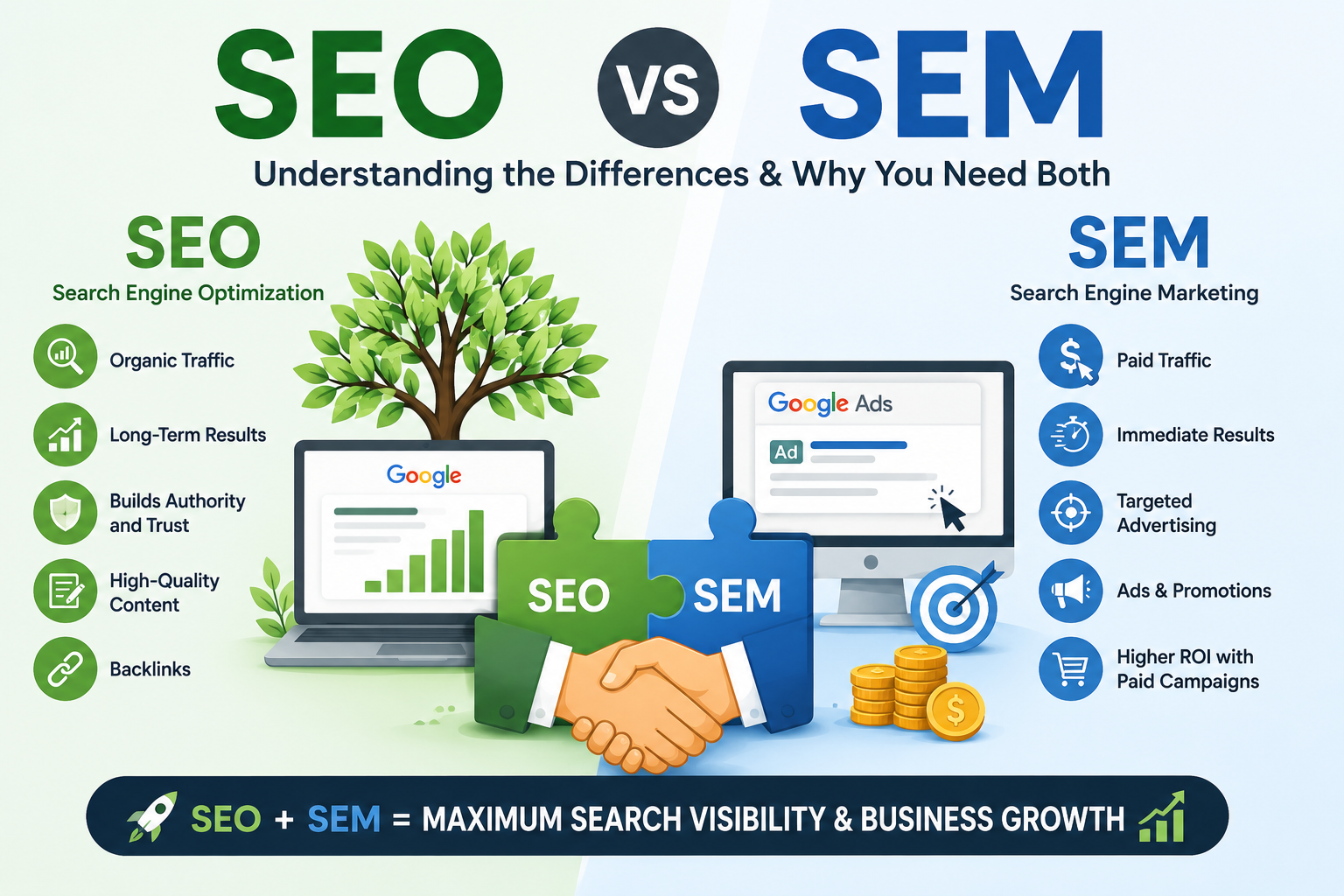
Two of the most effective strategies for improving search visibility are SEO (Search Engine Optimization) and SEM (Search Engine Marketing).
Although these terms are often used interchangeably, they serve different purposes and deliver results in different ways. Understanding how SEO and SEM work—and how they complement each other—can help businesses build a stronger digital marketing strategy.
What Is SEO (Search Engine Optimization)?
SEO is the process of optimizing a website to improve its visibility in organic (unpaid) search engine results.
The goal of SEO is to help your website rank higher for relevant search queries, making it easier for potential customers to find your business without paying for clicks.
Key Components of SEO
📄 On-Page SEO
Optimizing content, titles, headings, meta descriptions, and keywords to improve relevance and user experience.
🔗 Off-Page SEO
Building high-quality backlinks and improving domain authority through external signals.
⚙️ Technical SEO
Enhancing website speed, mobile responsiveness, site structure, crawlability, and indexing.
✍️ Content SEO
Creating valuable, optimized content that answers user questions and satisfies search intent.
Benefits of SEO
✅ Long-term organic traffic
✅ Increased website authority and credibility
✅ Higher trust among users
✅ Sustainable growth without paying for every click
What Is SEM (Search Engine Marketing)?
SEM focuses on increasing website visibility through paid advertising on search engines.
Unlike SEO, SEM provides immediate exposure by placing ads at the top of search results for targeted keywords.
Businesses pay for clicks, impressions, or conversions depending on campaign objectives.
Common SEM Strategies
💰 Pay-Per-Click (PPC) Advertising
Advertisers pay when users click their ads.
🖼️ Display Advertising
Visual ads shown across websites and advertising networks.
🔄 Remarketing Campaigns
Targeting users who previously visited your website but did not convert.
🎯 Shopping & Performance Campaigns
Promoting products directly within search results and Google’s advertising ecosystem.
Benefits of SEM
✅ Immediate visibility
✅ Faster lead generation
✅ Precise audience targeting
✅ Full control over budgets and campaigns
✅ Measurable and scalable results
SEO vs SEM: Key Differences
| Feature | SEO | SEM |
|---|---|---|
| Traffic Source | Organic Traffic | Paid Traffic |
| Cost | Time and resources | Cost per click/impression |
| Speed of Results | Long-term | Immediate |
| Visibility | Organic listings | Paid advertisements |
| Sustainability | Long-lasting | Stops when budget stops |
| Goal | Authority and growth | Fast traffic and conversions |
Why SEO and SEM Work Better Together
Many businesses mistakenly treat SEO and SEM as competing strategies. In reality, the most successful digital marketing campaigns combine both.
🚀 SEO Builds Long-Term Growth
SEO helps establish authority, trust, and consistent organic traffic over time.
⚡ SEM Delivers Immediate Results
SEM drives targeted traffic while SEO efforts gain momentum.
📈 Combined Search Dominance
Using both strategies allows businesses to appear in multiple positions on search results pages, increasing visibility and click-through rates.
For example:
- SEO content can attract organic traffic over time.
- SEM campaigns can generate immediate leads for new products, promotions, or seasonal offers.
Together, they create a balanced approach that supports both short-term and long-term growth.
Final Thoughts
SEO and SEM are not rivals—they are partners in a successful search marketing strategy.
SEO helps businesses build trust, authority, and sustainable organic traffic, while SEM delivers immediate visibility, targeted traffic, and faster conversions.
Businesses that leverage both strategies gain a competitive advantage by maximizing their presence across search engines and reaching customers at every stage of the buying journey.
🎯 Remember:
**SEO builds trust. SEM builds reach. Together, they build growth.