

If you’re running Google Ads campaigns, generating clicks is only part of the equation.
The real goal is turning those clicks into leads, sales, phone calls, or other valuable actions.
That’s where Conversion Rate comes in.
Conversion Rate is one of the most important metrics in PPC advertising because it measures how effectively your traffic turns into results.
A campaign generating thousands of clicks may still perform poorly if very few visitors convert.
In this guide, you’ll learn what Conversion Rate is, how it is calculated, why it matters, and how to improve Conversion Rates in your PPC campaigns.
What Is Conversion Rate in PPC?
Conversion Rate measures the percentage of visitors who complete a desired action after clicking your ad.
A conversion could be:
- Lead form submission
- Phone call
- Product purchase
- Appointment booking
- Demo request
- Newsletter signup
Conversion Rate helps advertisers understand how efficiently their campaigns convert traffic into business results.
How Is Conversion Rate Calculated?
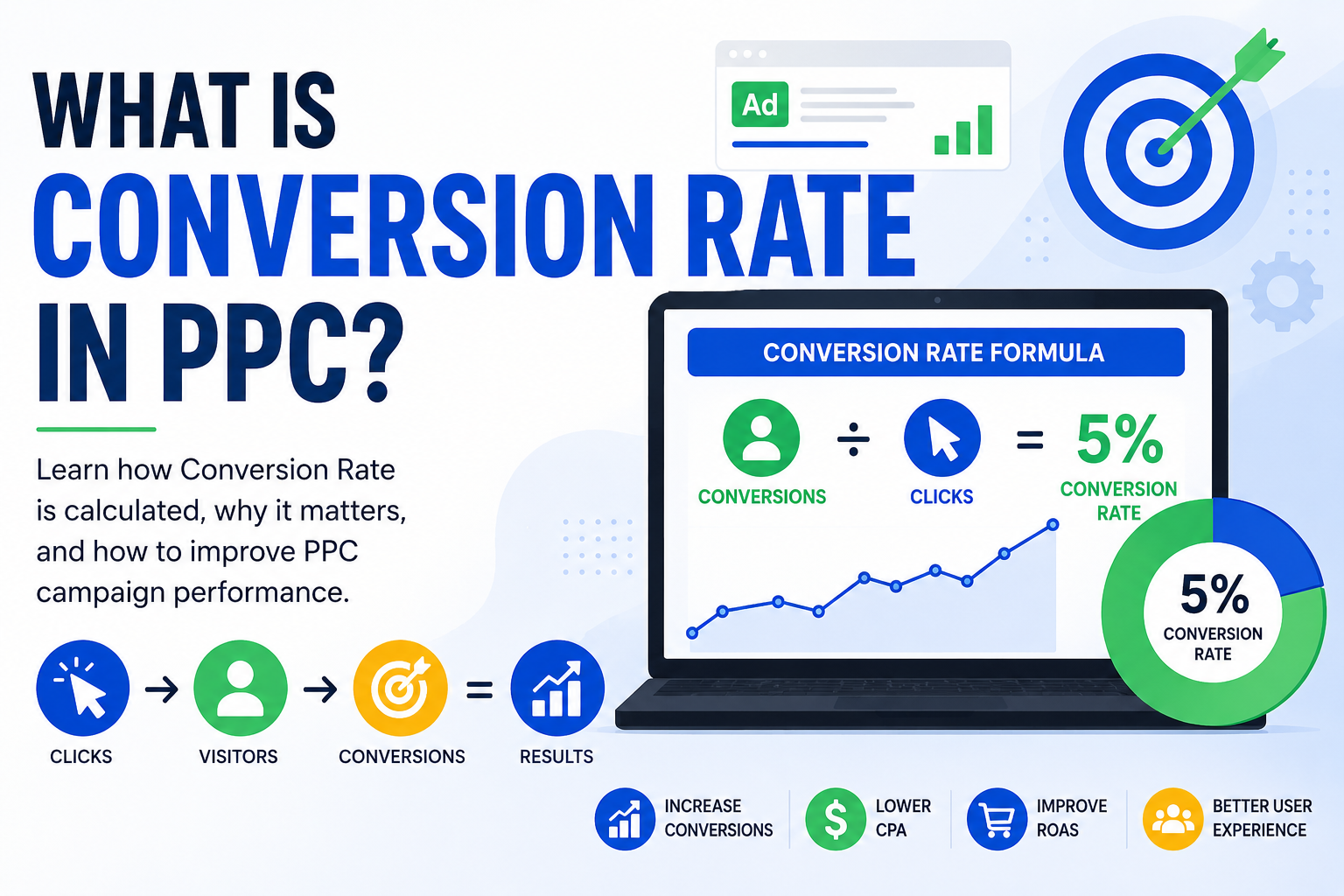
Conversion Rate is calculated using a simple formula:
Conversion Rate = (Conversions ÷ Clicks) × 100
Example
Clicks:
100
Conversions:
5
Conversion Rate:
5 ÷ 100 × 100 = 5%
This means 5% of visitors completed the desired action.
Why Is Conversion Rate Important?
Many advertisers focus on clicks, impressions, and traffic.
However, traffic alone doesn’t generate revenue.
Conversion Rate helps determine:
- Campaign effectiveness
- Landing page performance
- Lead generation efficiency
- Advertising profitability
- User experience quality
Higher Conversion Rates typically result in lower acquisition costs and improved campaign performance.
What Is a Good Conversion Rate?
There is no universal benchmark because Conversion Rates vary by industry and business type.
General guidelines include:
| Conversion Rate | Performance |
|---|---|
| Below 2% | Needs Improvement |
| 2% – 5% | Average |
| 5% – 10% | Good |
| 10%+ | Excellent |
Some industries achieve significantly higher or lower rates depending on competition and customer behavior.
The most important benchmark is improving your own results over time.
Conversion Rate vs CTR
Conversion Rate and Click-Through Rate (CTR) are different metrics.
CTR
Measures how many people click your ad after seeing it.
Formula:
CTR = Clicks ÷ Impressions × 100
Conversion Rate
Measures how many visitors complete a desired action after clicking.
Formula:
Conversion Rate = Conversions ÷ Clicks × 100
A campaign may have a high CTR but a poor Conversion Rate if visitors do not take action after reaching the website.
Conversion Rate vs CPA
These metrics work together.
Conversion Rate
Measures effectiveness.
CPA
Measures cost efficiency.
Generally:
Higher Conversion Rate = Lower CPA
When more visitors convert, advertising costs are spread across more conversions.
This often improves overall campaign profitability.
Conversion Rate vs ROAS
ROAS measures revenue generated from advertising.
Conversion Rate measures how effectively visitors convert.
Improving Conversion Rate often helps improve ROAS because more visitors become customers.
Factors That Influence Conversion Rate
Several factors impact Conversion Rate performance.
Landing Page Experience
Landing pages are often the biggest factor affecting conversions.
Focus on:
- Clear messaging
- Fast loading speeds
- Mobile responsiveness
- Strong calls-to-action
- Trust signals
Audience Targeting
Reaching the wrong audience usually lowers Conversion Rates.
Better targeting helps attract qualified visitors.
Ad Relevance
Ads should closely match user intent.
Relevant ads often generate higher-quality traffic.
Offer Quality
Strong offers generally convert better than weak or unclear offers.
Website Usability
Complicated forms, slow websites, and confusing navigation can reduce conversions.
How to Improve Conversion Rate
Improve Landing Pages
Optimize:
- Headlines
- Calls-to-action
- Page speed
- Mobile experience
- Form design
Small improvements can significantly increase conversions.
Improve Ad Copy
Set accurate expectations and align ad messaging with landing page content.
Use Negative Keywords
Negative keywords prevent irrelevant clicks.
This improves traffic quality and often increases Conversion Rates.
Focus on High-Intent Keywords
Keywords indicating strong buying intent often produce better results.
Examples:
- Google Ads consultant
- PPC management services
- Google Ads audit
Improve Conversion Tracking
Accurate tracking helps identify opportunities for optimization.
Without reliable tracking, improvement becomes difficult.
Common Conversion Rate Mistakes
Sending Traffic to the Homepage
Dedicated landing pages typically outperform generic homepages.
Targeting Broad Keywords
Broad targeting often produces less-qualified visitors.
Weak Calls-to-Action
Users should clearly understand the next step.
Ignoring Mobile Users
Many conversions occur on mobile devices.
Poor mobile experiences often reduce Conversion Rates.
Focusing Only on Traffic
More traffic does not always mean more conversions.
Quality matters more than quantity.
Benefits of Higher Conversion Rates
Businesses that improve Conversion Rates often experience:
- Lower CPA
- Higher ROAS
- Better profitability
- Improved lead quality
- Greater advertising efficiency
Even small improvements can produce significant revenue gains.
Conversion Rate by Business Type
Ecommerce
Measures purchases and transactions.
Lead Generation
Measures form submissions, calls, and inquiries.
Local Businesses
Measures bookings, appointments, and calls.
B2B Organizations
Measures consultations, demos, and lead submissions.
Regardless of industry, Conversion Rate remains one of the most important PPC metrics.
Frequently Asked Questions
What is Conversion Rate in PPC?
Conversion Rate measures the percentage of visitors who complete a desired action after clicking an ad.
How do you calculate Conversion Rate?
Conversion Rate is calculated by dividing conversions by clicks and multiplying by 100.
What is a good Conversion Rate?
Most campaigns achieve between 2% and 10%, although benchmarks vary by industry.
Why is Conversion Rate important?
Conversion Rate helps advertisers evaluate campaign effectiveness and profitability.
How can I improve Conversion Rate?
Improve landing pages, targeting, ad relevance, user experience, and conversion tracking.
Final Thoughts
Understanding Conversion Rate is essential for PPC success.
While clicks and traffic are important, Conversion Rate reveals how effectively those visitors turn into leads and customers.
Businesses that consistently improve Conversion Rates often reduce CPA, improve ROAS, and generate better advertising results without increasing budgets.
Whether you’re managing campaigns yourself or working with a PPC consultant, Conversion Rate should be one of the core metrics used to evaluate campaign performance.
If you’re unsure why your campaigns are not converting as expected, a professional Google Ads audit can help identify opportunities to improve conversion rates and overall performance.