
If you’re running Google Ads campaigns, choosing the right keywords is important. However, selecting the right keyword match type is equally critical.
Keyword match types determine how closely a user’s search intent must relate to your keyword before your ad can appear.
Using the wrong match type can result in wasted spend, irrelevant clicks, and poor campaign performance.
Using the right match type helps you reach the right audience while maintaining control over your advertising budget.
In this guide, you’ll learn what keyword match types are, how they work, and when to use each one.
What Are Keyword Match Types in Google Ads?
Keyword match types control how closely a user’s search intent must relate to your chosen keyword for your ad to be eligible to show.
Google Ads currently supports three primary match types:
- Broad Match
- Phrase Match
- Exact Match
Each match type offers a different balance between reach and control.
Google Ads no longer relies solely on exact keyword wording. Modern match types use intent, meaning, user behavior, and machine learning to determine when an ad may be eligible to appear.
Why Are Keyword Match Types Important?
Match types influence:
- Search volume
- Click quality
- CPC
- Conversion Rate
- CPA
- ROAS
Choosing the correct match type can significantly improve campaign performance.
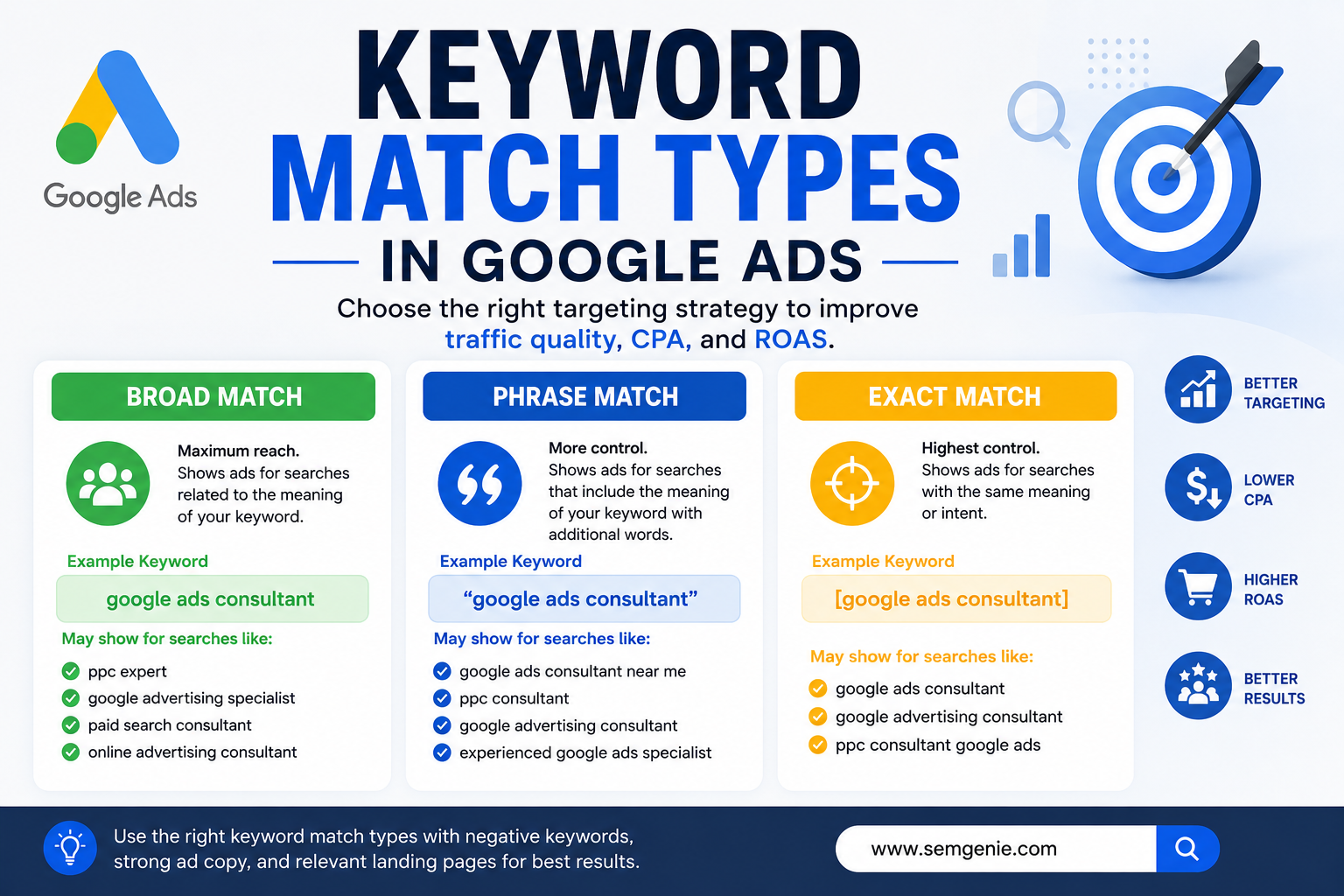
Broad Match
Broad Match is Google’s default keyword match type and provides the widest reach.
Example keyword:
google ads consultant
Your ad may appear for searches that are related to the meaning of your keyword, even if the exact words are not used.
Possible searches include:
- ppc expert
- google advertising specialist
- paid search consultant
- online advertising consultant
Google uses signals such as search intent, landing pages, previous searches, keyword meaning, and machine learning to determine relevance.
Advantages of Broad Match
- Maximum reach
- Discovers new search opportunities
- Works well with Smart Bidding
- Can increase conversion volume
Disadvantages of Broad Match
- Less control over search queries
- May generate irrelevant traffic
- Requires Search Terms Report reviews
- Requires strong negative keyword management
Broad Match is often recommended when using automated bidding strategies and accurate conversion tracking.
Phrase Match
Phrase Match allows your ads to show for searches that include the meaning of your keyword.
Example keyword:
“google ads consultant”
Your ad may appear for searches such as:
- google ads consultant near me
- ppc consultant
- google advertising consultant
- experienced google ads specialist
The search query must reflect the meaning of your keyword, but additional words may be included before or after the phrase.
Advantages of Phrase Match
- Better relevance than Broad Match
- More control over targeting
- Strong balance between reach and precision
- Often a good starting point for many campaigns
Disadvantages of Phrase Match
- Lower reach than Broad Match
- Still requires Search Terms Report monitoring
- Can occasionally trigger unexpected searches
Phrase Match is often the preferred balance between traffic volume and traffic quality.
Exact Match
Exact Match provides the highest level of control.
Example keyword:
[google ads consultant]
Your ad may appear for searches that have the same meaning or intent as your keyword.
Examples may include:
- google ads consultant
- google advertising consultant
- ppc consultant google ads
Google may still match close variants and searches with the same intent, even when the wording differs slightly.
Advantages of Exact Match
- Highest targeting control
- Better traffic quality
- Easier keyword performance analysis
- Strong budget control
Disadvantages of Exact Match
- Lower search volume
- Fewer opportunities to discover new keywords
- May limit campaign growth if used exclusively
Exact Match is often used for proven, high-performing keywords where efficiency and lead quality are priorities.
Broad Match vs Phrase Match vs Exact Match
| Match Type | Reach | Control | Best For |
|---|---|---|---|
| Broad Match | Highest | Lowest | Discovery and scale |
| Phrase Match | Medium | Medium | Balance of reach and relevance |
| Exact Match | Lowest | Highest | Efficiency and lead quality |
There is no universally “best” match type.
The ideal choice depends on campaign goals, budget, and targeting requirements.
Which Match Type Should You Use?
Use Broad Match When
- Using Smart Bidding
- Looking for growth opportunities
- Discovering new search terms
- Managing larger budgets
- Using strong conversion tracking
Use Phrase Match When
- Seeking balance between reach and control
- Expanding campaigns safely
- Testing new keyword themes
- Looking for quality traffic without restricting volume
Use Exact Match When
- Targeting proven keywords
- Maximizing efficiency
- Managing tight budgets
- Prioritizing lead quality
- Controlling spend carefully
Many successful campaigns use a combination of all three match types.
The Role of Negative Keywords
Match types alone cannot prevent irrelevant searches.
Negative keywords help eliminate unwanted traffic.
For example:
Keyword:
google ads consultant
Negative Keyword:
free
This helps prevent ads from showing for searches such as:
- free google ads consultant
- free ppc training
- google ads course free
Negative keywords are essential for improving traffic quality and controlling costs.
Common Match Type Mistakes
Using Only Broad Match
Broad Match without proper monitoring can generate irrelevant clicks and wasted spend.
Ignoring Search Terms Reports
Always review Search Terms Reports to identify new keyword opportunities and negative keywords.
Using Too Many Exact Match Keywords
This can limit growth opportunities and reduce campaign scalability.
Not Using Negative Keywords
Negative keywords are critical for maintaining campaign efficiency.
Choosing Match Types Without Conversion Tracking
Without conversion data, it becomes difficult to evaluate whether a match type is actually driving business results.
How Match Types Impact CPA and ROAS
Match types directly influence campaign profitability.
Better targeting often results in:
- Higher Conversion Rates
- Lower CPA
- Improved ROAS
- Better lead quality
Poor targeting often produces the opposite results.
Choosing the correct match type helps ensure your budget is spent on relevant searches.
Frequently Asked Questions
What are keyword match types in Google Ads?
Keyword match types determine how closely a user’s search intent must match your keyword before your ad becomes eligible to appear.
What are the three keyword match types?
Google Ads currently supports:
- Broad Match
- Phrase Match
- Exact Match
Which keyword match type is best?
There is no single best option. The ideal match type depends on campaign goals, budget, targeting requirements, and conversion data.
Does Google still support Broad Match Modifier?
No. Google retired Broad Match Modifier and incorporated many of its capabilities into Phrase Match.
Should I use negative keywords with all match types?
Yes. Negative keywords help improve traffic quality, reduce wasted spend, lower CPA, and improve ROAS.
Final Thoughts
Understanding keyword match types is essential for building successful Google Ads campaigns.
Broad Match, Phrase Match, and Exact Match each serve different purposes and offer different levels of reach and control.
Modern Google Ads match types focus heavily on search intent and keyword meaning rather than exact wording alone.
Advertisers who understand how match types work can improve traffic quality, reduce wasted spend, lower CPA, increase Conversion Rates, and improve ROAS.
Whether you’re managing campaigns yourself or working with a PPC consultant, mastering keyword match types is a fundamental Google Ads skill.
If you’re unsure whether your keyword strategy is generating the right traffic, a professional Google Ads audit can help identify opportunities to improve targeting, reduce wasted spend, and increase campaign performance.