

If you’re running Google Ads without conversion tracking, you’re essentially advertising blind.
Clicks, impressions, and CTR provide useful information, but they don’t tell you whether your campaigns are generating leads, sales, phone calls, or revenue.
That’s where conversion tracking comes in.
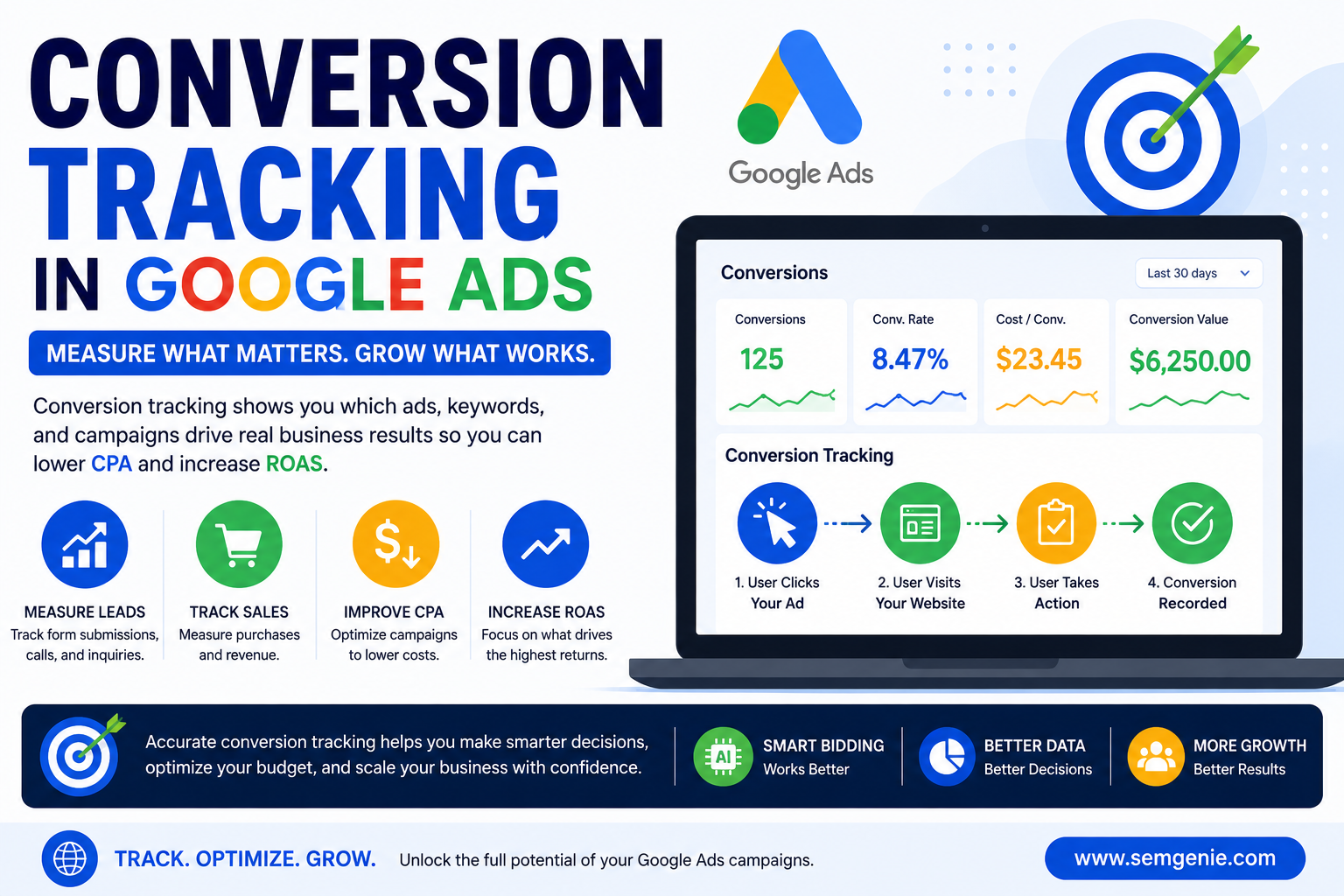
Conversion tracking allows advertisers to measure the actions users take after interacting with an ad. It is one of the most important components of a successful PPC campaign.
In this guide, you’ll learn what conversion tracking is, how it works, why it matters, and how to use it to improve campaign performance.
What Is Conversion Tracking?
Conversion tracking is a feature in Google Ads that measures valuable actions completed by users after clicking or viewing an ad.
These actions are known as conversions.
Examples include:
- Form submissions
- Phone calls
- Purchases
- Appointment bookings
- Demo requests
- Newsletter signups
Conversion tracking helps advertisers understand which campaigns, keywords, ads, and audiences generate results.
Why Is Conversion Tracking Important?
Without conversion tracking, you cannot accurately measure campaign success.
Conversion tracking helps advertisers:
- Measure ROI
- Improve CPA
- Increase ROAS
- Optimize bids
- Identify high-performing keywords
- Eliminate wasted spend
Google’s Smart Bidding strategies also rely heavily on accurate conversion data.
How Does Conversion Tracking Work?
The process is simple:
- User clicks an ad.
- User visits your website.
- User completes a desired action.
- Google Ads records the conversion.
This allows advertisers to connect ad spend with business outcomes.
Types of Conversions in Google Ads
Website Conversions
Track actions completed on your website such as:
- Form submissions
- Purchases
- Lead generation
- Downloads
Phone Call Conversions
Track calls generated from:
- Call extensions
- Call-only ads
- Website phone numbers
App Conversions
Track app installs and in-app actions.
Imported Conversions
Import conversions from:
- Google Analytics
- CRM systems
- Offline sales systems
Common Conversion Tracking Methods
Google Tag
Google Ads tracking code installed directly on the website.
Google Tag Manager
A flexible solution that allows tracking deployment without modifying website code repeatedly.
Google Analytics 4
Many advertisers import conversions from GA4 into Google Ads.
Offline Conversion Import
Useful for businesses where sales occur offline after leads are generated.
What Happens Without Conversion Tracking?
Without conversion tracking:
- Smart Bidding becomes less effective
- CPA calculations become inaccurate
- ROAS cannot be measured properly
- Budget decisions become guesswork
- Campaign optimization becomes difficult
Many underperforming accounts simply have poor tracking.
Conversion Tracking and Smart Bidding
Google’s automated bidding strategies rely on conversion data.
Examples include:
- Maximize Conversions
- Maximize Conversion Value
- Target CPA
- Target ROAS
Accurate tracking improves bidding performance.
Common Conversion Tracking Mistakes
Tracking Page Views as Conversions
Not every page view represents meaningful business value.
Tracking Too Many Actions
Tracking everything can confuse optimization signals.
Duplicate Conversions
Incorrect implementation may cause conversions to be counted multiple times.
Missing Conversion Values
Revenue-based businesses should assign conversion values whenever possible.
Ignoring Lead Quality
Not all conversions are equal.
A qualified lead is more valuable than a low-quality inquiry.
How Conversion Tracking Impacts CPA and ROAS
Conversion tracking directly influences:
CPA
CPA cannot be calculated accurately without conversion tracking.
ROAS
Revenue attribution depends on accurate tracking.
Conversion Rate
Conversion Rate calculations require reliable conversion data.
Better tracking leads to better optimization decisions.
Benefits of Accurate Conversion Tracking
Businesses with proper conversion tracking often achieve:
- Lower CPA
- Better ROAS
- Improved lead quality
- Better budget allocation
- Stronger campaign performance
Accurate data drives better decisions.
Frequently Asked Questions
What is conversion tracking in Google Ads?
Conversion tracking measures actions users complete after interacting with your ads.
Why is conversion tracking important?
It helps advertisers measure performance, improve ROI, and optimize campaigns.
Can I use Google Analytics for conversion tracking?
Yes. Many advertisers import GA4 conversions into Google Ads.
What should I track as a conversion?
Track actions that create real business value, such as leads, sales, calls, and appointments.
Does Smart Bidding require conversion tracking?
Yes. Smart Bidding performs best when accurate conversion data is available.
Final Thoughts
Conversion tracking is the foundation of successful Google Ads management.
Without accurate tracking, advertisers cannot reliably measure CPA, ROAS, Conversion Rate, or overall campaign profitability.
Whether you’re managing campaigns yourself or working with a PPC consultant, proper conversion tracking should always be one of the first priorities in any Google Ads account.