

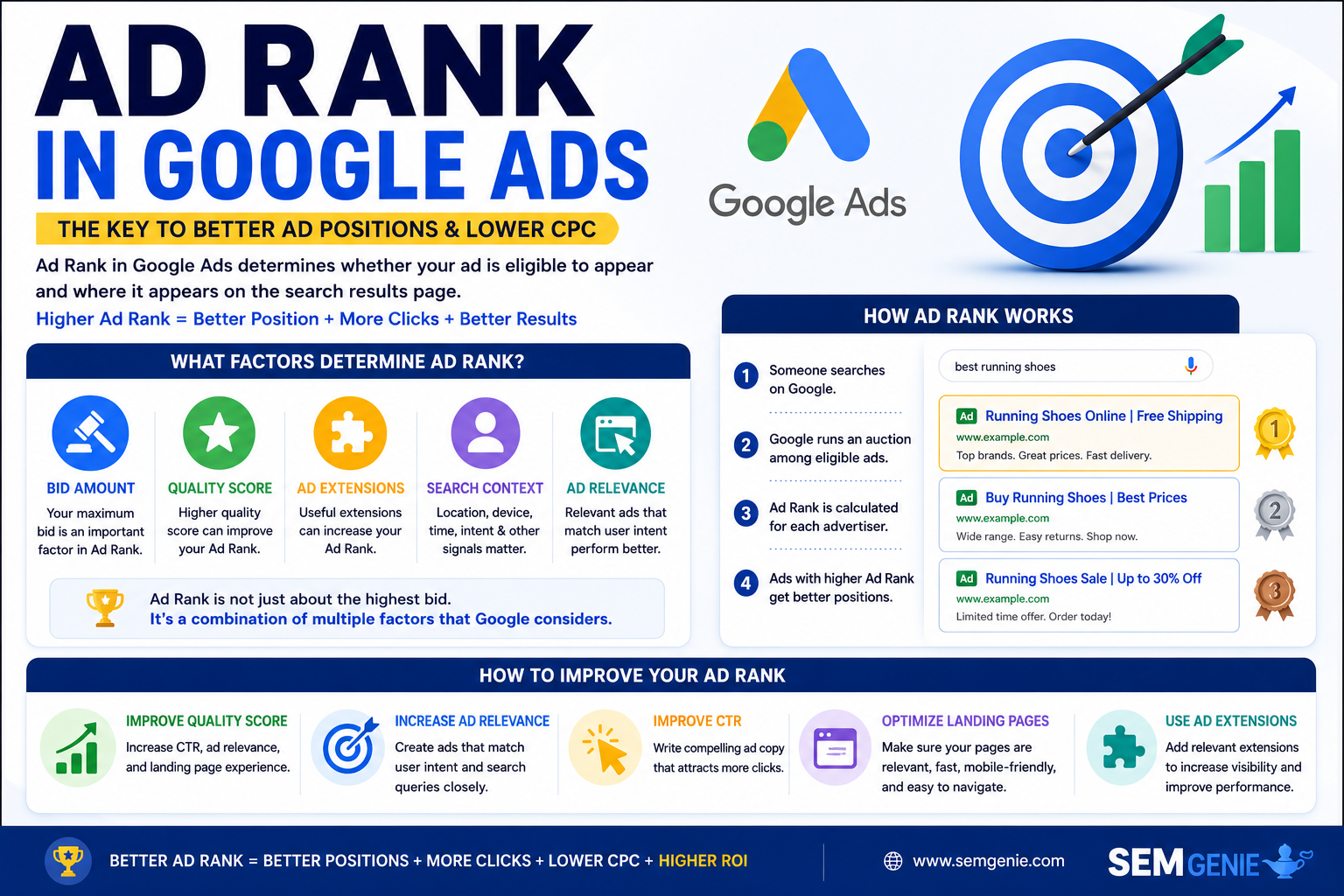
Ad Rank in Google Ads determines whether your ad is eligible to appear and where it appears on the search results page. Understanding Ad Rank in Google Ads is essential for improving visibility, increasing clicks, and maximizing PPC performance.
Many advertisers assume that the highest bidder always wins the top position. However, Google Ads uses a more sophisticated system.
Ad Rank helps Google determine which ads provide the best experience for users while maintaining advertiser competition.
In this guide, you’ll learn what Ad Rank is, how it works, and how to improve it.
What Is Ad Rank in Google Ads?
Ad Rank in Google Ads is the value Google uses to determine:
- Whether your ad appears
- Where your ad appears
- Which advertiser wins an auction
Every time a search occurs, Google calculates Ad Rank for eligible advertisers.
Higher Ad Rank generally results in better ad positions.
Why Is Ad Rank Important?
Ad Rank directly impacts:
- Ad visibility
- Click volume
- CPC
- Conversion opportunities
- Campaign performance
A higher Ad Rank can often help advertisers achieve better positions without dramatically increasing bids.
How Is Ad Rank Calculated?
Google considers several factors:
Bid Amount
Your maximum bid influences Ad Rank.
However, the highest bid does not automatically win.
Quality Score
Quality Score measures:
- Expected CTR
- Ad Relevance
- Landing Page Experience
Higher Quality Scores often improve Ad Rank.
Ad Extensions
Google evaluates the expected impact of:
- Sitelinks
- Callouts
- Structured Snippets
- Call Extensions
Useful extensions can improve Ad Rank.
Search Context
Google considers:
- User location
- Device
- Search intent
- Time of day
- Competition
Ad Rank may vary across searches.
Ad Rank vs Quality Score
Many advertisers confuse these metrics.
Quality Score
Measures keyword quality.
Ad Rank
Determines ad position.
Quality Score is one factor used when calculating Ad Rank.
Improving Quality Score often improves Ad Rank.
Ad Rank vs CPC
Ad Rank and CPC are closely related.
Higher Ad Rank often allows advertisers to:
- Achieve better positions
- Maintain lower CPCs
- Generate more clicks
Improving Ad Rank can be more effective than simply increasing bids.
How to Improve Ad Rank
Improve Quality Score
Focus on:
- Relevant keywords
- Better ad copy
- Landing page experience
Increase Ad Relevance
Ensure ads closely match user intent.
Improve CTR
Higher click-through rates often contribute to stronger performance.
Use Ad Extensions
Ad extensions improve visibility and user experience.
Optimize Landing Pages
Fast, relevant, mobile-friendly landing pages help support Ad Rank.
Common Ad Rank Mistakes
Increasing Bids Without Improving Quality
Higher bids alone may not solve performance issues.
Ignoring Landing Pages
Poor landing pages can reduce overall performance.
Not Using Ad Extensions
Missing extensions may reduce competitiveness.
Low Ad Relevance
Generic ads often perform poorly.
Benefits of Higher Ad Rank
Businesses with stronger Ad Rank often experience:
- Better ad positions
- More clicks
- Higher CTR
- Better lead volume
- Improved campaign efficiency
Frequently Asked Questions
What is Ad Rank in Google Ads?
Ad Rank is the value Google uses to determine ad eligibility and ad position.
Does the highest bid always win?
No. Google also considers Quality Score, ad relevance, extensions, and user experience.
How can I improve Ad Rank?
Improve Quality Score, ad relevance, CTR, landing pages, and ad extensions.
Does Ad Rank affect CPC?
Yes. Better Ad Rank can help advertisers achieve stronger positions at lower CPCs.
Final Thoughts
Ad Rank in Google Ads is one of the most important concepts advertisers should understand.
A strong Ad Rank helps improve visibility, increase clicks, and maximize advertising performance without relying solely on higher bids.
Businesses that focus on Quality Score, ad relevance, landing page experience, and user intent often achieve better Ad Rank and stronger PPC results.