

- Introduction
- Is There an Ideal Google Ads Budget?
- What Determines Your Google Ads Budget?
- Recommended Budgets for Different Businesses
- Common Google Ads Budget Mistakes
- Frequently Asked Questions
- Final Thoughts
Introduction
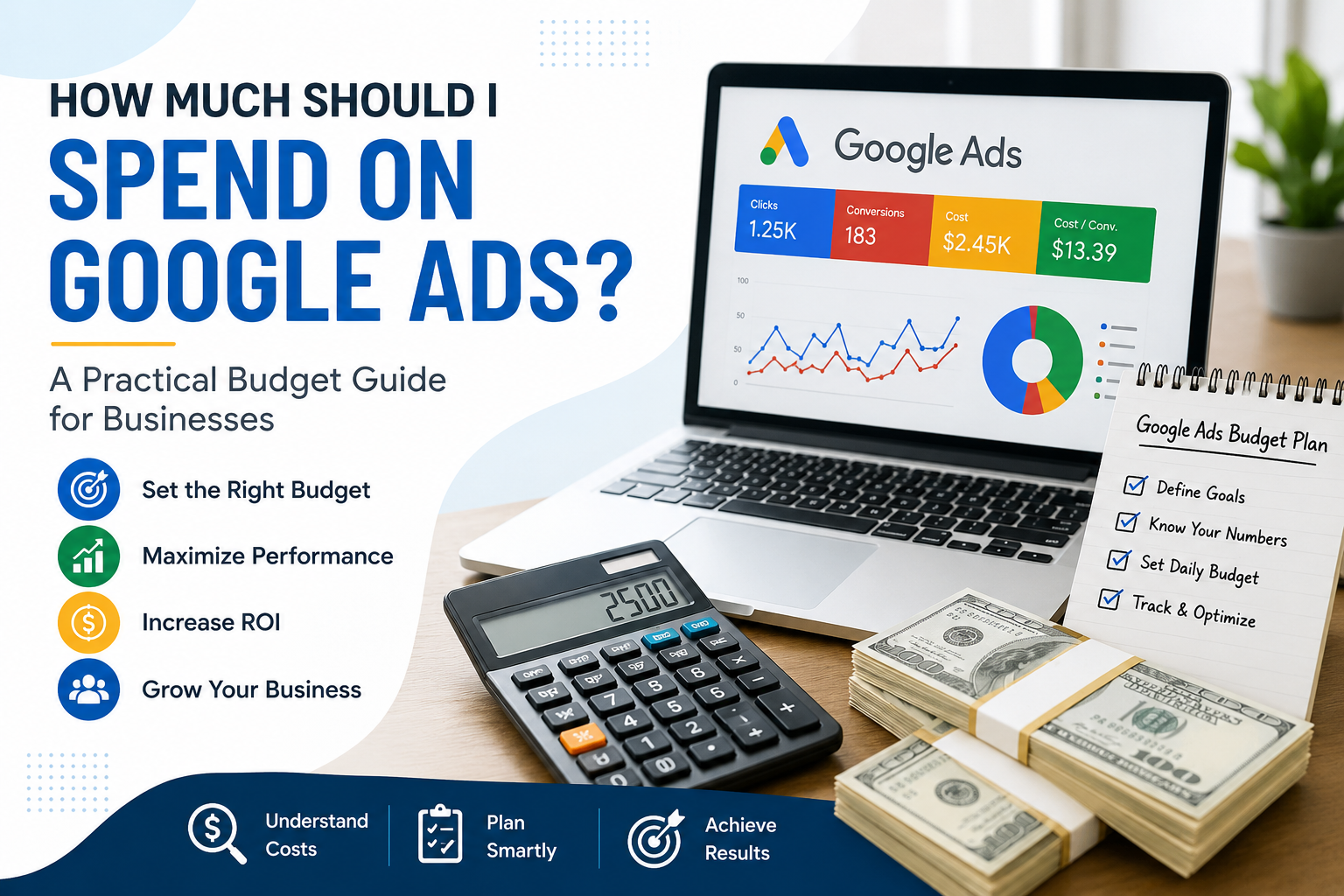
One of the first questions businesses ask before launching a campaign is, “How much should I spend on Google Ads?”Unfortunately, there isn’t a single answer that works for every business.
Your ideal Google Ads budget depends on several factors, including your industry, competition, business goals, customer lifetime value, and the average Cost Per Click (CPC) for your target keywords. A budget that’s too low may limit your campaign’s ability to generate meaningful results, while spending more without a clear strategy can quickly lead to wasted ad spend.
The good news is that you don’t need an unlimited budget to succeed with Google Ads. By understanding how Google Ads budgets work and allocating your advertising spend strategically, you can generate qualified leads and maximize your return on investment.
In this guide, you’ll learn how to determine the right Google Ads budget for your business, avoid common budgeting mistakes, and make informed decisions that support long-term growth.
Is There an Ideal Google Ads Budget?
There is no universal Google Ads budget that works for every business. A local service provider, an eCommerce store, and a B2B software company all have different advertising costs, customer values, and competitive landscapes.
Instead of asking, “What’s the perfect budget?”, a better question is:
“What budget gives my campaign enough data to generate profitable results?”
Google Ads works best when campaigns receive enough clicks and conversions to optimise performance. If your budget is too low, your ads may receive limited impressions, fewer clicks, and insufficient data to improve over time.
A realistic budget should allow you to:
- Reach your target audience consistently.
- Generate enough clicks to evaluate campaign performance.
- Collect meaningful conversion data.
- Optimise campaigns based on real results rather than assumptions.
Rather than focusing only on spending less, focus on investing a budget that allows your campaigns to achieve your business goals while delivering a positive return on investment.
What Determines Your Google Ads Budget?
Several factors influence how much you should invest in Google Ads. Understanding these variables will help you set a realistic budget that supports your business goals.
1. Your Industry
Some industries are far more competitive than others. For example, legal, insurance, finance, and SaaS keywords often have much higher Cost Per Click (CPC) than local service businesses.
2. Your Business Goals
Your budget should align with your objectives. A business looking to generate a few local enquiries each month will require a different budget than an eCommerce store aiming for hundreds of online sales.
3. Competition
The more advertisers competing for the same keywords, the higher the potential CPC. Competitive markets typically require larger budgets to maintain visibility.
4. Average Cost Per Click (CPC)
Knowing your industry’s average CPC helps estimate how many clicks your budget can realistically generate each month.
5. Conversion Rate
A website that converts visitors efficiently can often achieve better results with the same advertising budget. Improving your conversion rate is frequently more cost-effective than simply increasing ad spend.
6. Customer Lifetime Value (LTV)
Businesses with high customer lifetime value can often justify spending more to acquire new customers because each conversion generates greater long-term revenue.
Before increasing your Google Ads budget, ensure your campaigns are already optimized. Scaling inefficient campaigns usually increases wasted ad spend rather than improving results.
Recommended Budgets for Different Businesses
Recommended Budgets for Different Businesses
There isn’t a universal Google Ads budget because advertising costs vary by industry, competition, and target market. However, the following ranges provide a practical starting point for many businesses.
| Business Type | Suggested Monthly Budget (USD) |
|---|---|
| Local Service Business | $500 – $1,500 |
| Small Business | $1,000 – $3,000 |
| Growing eCommerce Store | $2,000 – $10,000+ |
| B2B Lead Generation | $2,000 – $8,000+ |
| Mid-Sized Business | $3,000 – $15,000+ |
| Enterprise Business | Based on growth targets and ROI |
🌍 Global Budget Tip
Google Ads costs vary significantly by country, industry, and competition. A budget that’s sufficient in one market may be too low—or unnecessarily high—in another. Always determine your budget based on your target audience, Cost Per Click (CPC), expected conversion rate, and Return on Investment (ROI), rather than copying another business’s budget.
These are general guidelines rather than fixed recommendations. Some businesses can achieve excellent results with smaller budgets, while highly competitive industries may require significantly larger investments.
Rather than asking, “How much should I spend?”, ask:
“How much can I profitably invest to acquire a new customer?”
That question leads to far better budgeting decisions than choosing an arbitrary monthly spend.
Common Google Ads Budget Mistakes
Setting an Unrealistically Low Budget
A budget that’s too small may prevent your campaigns from collecting enough data to optimise performance effectively.
Increasing Budget Before Optimising Campaigns
If your campaigns aren’t converting, spending more rarely solves the problem. Optimise keywords, ads, landing pages, and conversion tracking first.
Focusing Only on Cost
The cheapest clicks aren’t always the most valuable. A higher CPC that generates profitable customers is often a better investment than inexpensive clicks that never convert.
Ignoring Return on Investment
Successful advertisers measure profitability, not just advertising spend. Always evaluate your campaigns using metrics such as Cost Per Acquisition (CPA), Return on Ad Spend (ROAS), and overall business revenue.
Making Frequent Budget Changes
Constantly increasing or decreasing budgets can disrupt campaign performance, especially when using automated bidding strategies. Make gradual adjustments and allow sufficient time to evaluate results.
Frequently Asked Questions
What is the minimum budget for Google Ads?
Google Ads doesn’t require a minimum budget. However, your budget should be sufficient to generate enough clicks and conversions to evaluate campaign performance effectively.
Is $20 per day enough for Google Ads?
For some local businesses and niche markets, a $20 daily budget may be enough to generate valuable leads. In highly competitive industries, however, a larger budget may be required to achieve meaningful results.
Should I increase my Google Ads budget if my campaigns are performing well?
Yes. If your campaigns are consistently generating profitable leads or sales, gradually increasing your budget can help you reach more potential customers while maintaining a positive return on investment.
Should I start with a large Google Ads budget?
Not necessarily. Many businesses begin with a moderate budget, optimise their campaigns, and increase spending once they identify profitable keywords, audiences, and bidding strategies.
How do I know if my Google Ads budget is too low?
If your campaigns are frequently limited by budget, receive very few impressions, or don’t generate enough conversions to optimise performance, it may be time to increase your budget.
Should I focus on budget or ROI?
Return on investment should always be your primary focus. A campaign with a higher budget can still be highly profitable if it consistently generates qualified leads or sales at an acceptable Cost Per Acquisition (CPA).
Final Thoughts
There is no perfect Google Ads budget that works for every business. The right budget depends on your goals, competition, customer value, and campaign performance.
Rather than focusing solely on spending more, concentrate on building well-structured campaigns that attract qualified traffic, generate conversions, and deliver a positive return on investment. Once your campaigns are consistently profitable, you can confidently scale your advertising budget.
If you’re unsure how much you should invest in Google Ads, SEM Genie can help. Whether you need a Google Ads Audit, PPC Consulting, or Google Ads Management, we’ll help you determine a realistic budget, eliminate wasted ad spend, and maximise your advertising ROI.