

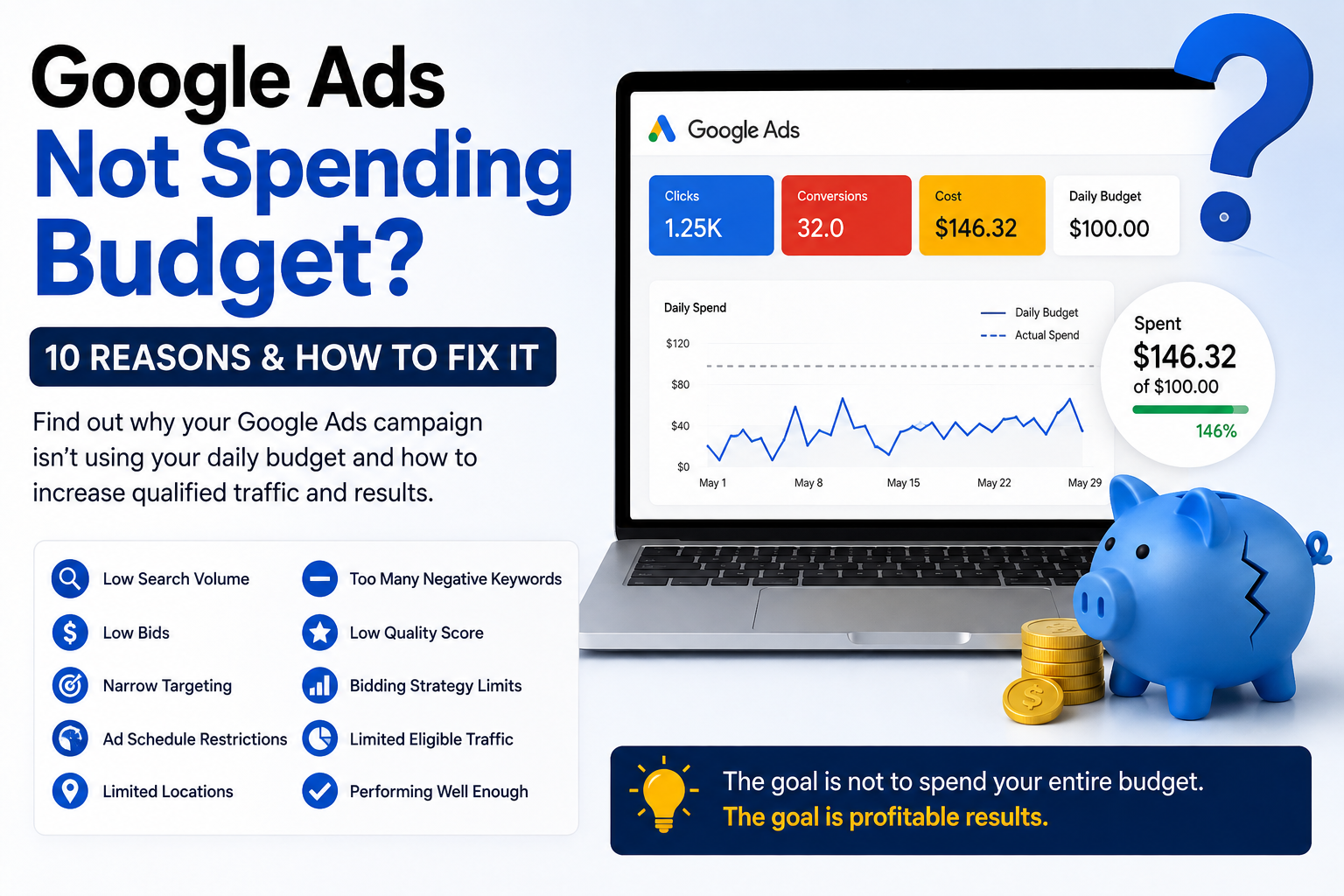
Google Ads Not Spending Budget? If your Google Ads campaign has a daily budget available but isn’t spending it, you may wonder whether something is wrong. Google Ads not spending budget can happen because of low search volume, restrictive targeting, low bids, Quality Score, ad scheduling, or bidding strategy. This guide explains why your campaign may be underspending and what you can do about it
Understanding why your Google Ads campaign isn’t spending its budget can help you decide whether you should increase bids, expand targeting, improve your ads, or simply leave the campaign as it is.
Why Is Google Ads Not Spending Budget?
Your daily budget is the maximum average amount you’re willing to spend for a campaign each day. It doesn’t mean Google will automatically spend that amount.
If there isn’t enough eligible traffic or Google doesn’t find enough opportunities that meet your campaign’s targeting and bidding requirements, the campaign may spend less than its daily budget.
In fact, underspending can sometimes be a good thing if the available traffic isn’t likely to generate profitable conversions.
10 Reasons Google Ads Isn’t Spending Your Daily Budget
1. Your Keywords Have Low Search Volume
If your keywords aren’t searched frequently, Google has fewer opportunities to show your ads.
What to do:
- Add relevant keywords.
- Review keyword search volume.
- Consider closely related search terms.
- Avoid targeting extremely narrow phrases.
2. Your Bids Are Too Low
If your bids aren’t competitive enough, your ads may lose auctions even when relevant searches are available.
Review your bids and Ad Rank before simply increasing your budget.
3. Your Targeting Is Too Narrow
Restrictive targeting can significantly reduce the number of people eligible to see your ads.
Check:
- Location targeting
- Language
- Audience settings
- Devices
- Ad schedule
Expanding targeting can increase delivery, but only do so when the additional traffic is relevant to your business.
4. Your Quality Score Is Low
Poor ad relevance and landing page experience can make it harder for your ads to compete.
Improve:
- Ad relevance
- Expected CTR
- Landing page experience
- Keyword-to-ad alignment
A stronger campaign can sometimes generate more traffic without increasing bids significantly.
5. Your Ad Schedule Is Too Restrictive
If your ads only run during a few hours each day, there may simply not be enough eligible searches during those periods.
Review performance by hour and day before restricting your schedule.
6. Your Location Targeting Is Too Limited
A very small geographic area may not generate enough searches to use your available budget.
If your business can serve additional locations, consider testing them separately rather than immediately expanding everything.
7. Your Negative Keywords Are Too Aggressive
Negative keywords are essential for controlling wasted spend, but an overly aggressive negative keyword list can block valuable searches.
Review your Search Terms Report and make sure relevant searches aren’t being excluded.
8. Your Bidding Strategy Is Restricting Delivery
Some automated bidding strategies may be selective about which auctions they enter based on your conversion goals and available data.
Review your bidding strategy, conversion history, and campaign goals before making major changes.
9. Your Campaign Has Limited Eligible Traffic
Sometimes the simple explanation is that there aren’t enough searches that meet all of your requirements.
This is particularly common with:
- Highly specific B2B services
- Niche products
- Small geographic markets
- Highly specific keywords
In these cases, increasing the budget won’t necessarily increase spending.
10. Your Campaign Is Performing Well Enough Without Spending More
Underspending isn’t automatically a problem.
If you’re generating profitable conversions at a good CPA or ROAS, there may be no reason to force Google to spend the entire budget.
The goal should be profitable growth, not spending your entire budget.
Should You Increase Your Bids?
Possibly, but don’t increase bids simply because your campaign is underspending.
First determine whether:
- Search volume is sufficient.
- Your targeting is too narrow.
- Your ads are competitive.
- Your Quality Score needs improvement.
- Your bidding strategy is appropriate.
If your campaign has strong conversion performance but is losing valuable impression share because of rank, increasing bids may make sense.
Should You Increase Your Daily Budget?
Usually, no.
If Google isn’t spending your existing budget, increasing the budget doesn’t solve the underlying problem.
For example, if you’re spending $20 of a $100 daily budget because there are only a limited number of relevant searches, changing the budget to $150 won’t automatically create more searches.
Fix delivery limitations first.
How to Increase Google Ads Spend Without Wasting Money
If you genuinely want to capture more qualified traffic, consider:
- Expanding relevant keyword coverage.
- Testing additional locations.
- Improving ad relevance.
- Reviewing negative keywords.
- Adjusting bids where appropriate.
- Testing broader but still relevant targeting.
- Improving landing page conversion rates.
- Reviewing your bidding strategy.
Make changes gradually and monitor conversion quality.
Final Thoughts
If Google Ads Not Spending Budget is a problem for your campaign, don’t assume that increasing your daily budget is the solution.
Google may be underspending because your keywords have low search volume, your targeting is restrictive, your bids aren’t competitive, or your campaign simply doesn’t have enough qualified traffic.
More importantly, spending less than your budget isn’t necessarily bad. If your campaign is generating profitable conversions, efficiency matters more than forcing Google to spend every available dollar.
If your campaign consistently underspends and you’re unsure why, a professional Google Ads Audit can help identify whether the limitation comes from targeting, keywords, bidding, campaign structure, or available search demand.
Frequently Asked Questions
Why isn’t Google spending my daily budget?
Common reasons include low search volume, restrictive targeting, low bids, poor ad relevance, limited locations, or bidding strategies that are selective about available auctions.
Should I increase my Google Ads budget if it’s not spending?
Usually not. If Google isn’t using your current budget, first identify why. Increasing the budget won’t create additional search demand.
Is it bad if Google Ads doesn’t spend the full budget?
No. Underspending can be perfectly normal, especially when there aren’t enough relevant searches or when Google doesn’t find enough suitable opportunities.
How can I make Google Ads spend more?
You can expand relevant keyword coverage, broaden appropriate targeting, review negative keywords, improve Ad Rank, and adjust bids or bidding strategies where justified.
Why is my campaign spending less after changing to Smart Bidding?
Smart Bidding may become more selective based on your conversion goals and available data. Review conversion tracking and campaign performance before making major changes.