

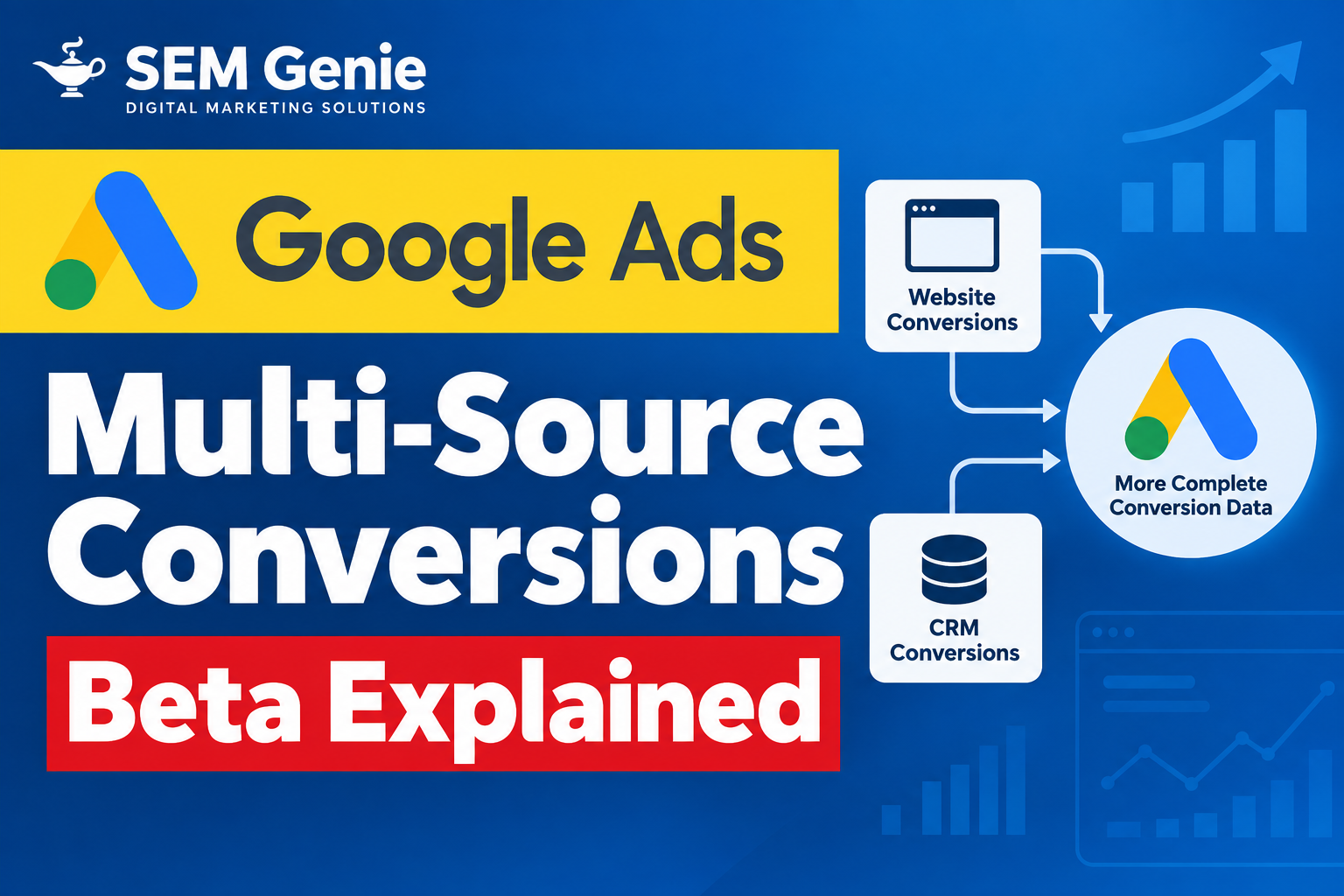
Google Ads is testing Multi-Source Conversions, a new beta feature designed to help advertisers provide Google Ads with more complete conversion information.
For businesses that rely on lead generation, CRM systems, or backend sales data, this could be an important development in Google Ads conversion tracking.
Traditionally, many advertisers measure a conversion when someone completes an action on their website, such as submitting a lead form.
But that isn’t always the conversion that matters most.
A business may care more about whether that lead became a qualified opportunity, customer, or sale.
Multi-Source Conversions is designed to help bridge that gap.
What Are Google Ads Multi-Source Conversions?
Google Ads Multi-Source Conversions allows an advertiser to connect an additional data source to an existing website conversion action.
That additional source can contain information from systems such as a CRM or backend database.
The idea is to combine the information collected from the website with additional first-party conversion information.
For example:
Google Ad → Website → Lead Form → CRM → Qualified Lead → Customer
Instead of stopping measurement at the form submission, advertisers can provide additional information about what happened later in the customer journey.
Why Is This Important for PPC?
A website conversion does not always represent a valuable business outcome.
For example:
- 100 people submit a lead form
- 60 leads are contacted
- 25 become qualified leads
- 8 become customers
If Google Ads only receives the original form submission, its optimization signal may not fully reflect which leads ultimately generated revenue.
CRM and backend data can provide additional information about those outcomes.
This can be particularly relevant for:
- B2B lead generation
- Education
- Real estate
- Financial services
- Healthcare
- Professional services
- High-ticket products and services
How Does It Work?
The basic concept is:
Website conversion data + additional conversion data source → more complete conversion information
The additional data can include information such as:
- Conversion date and time
- Transaction ID
- GCLID
- Customer information
- Conversion value
- CRM or transaction information
Google can then use the additional information to improve conversion measurement.
The exact implementation and eligibility requirements depend on the Google Ads account and conversion setup.
Multi-Source Conversions and Smart Bidding
One of the most interesting aspects of this beta is its relationship with Smart Bidding.
Better conversion data can give automated bidding systems better signals about the outcomes advertisers actually care about.
For example, an advertiser may currently optimize for:
Lead submitted
but ultimately care about:
Qualified lead
or:
Customer acquired
Providing better downstream conversion information can help align measurement more closely with the business objective.
However, advertisers should not assume that simply connecting another data source will automatically improve campaign performance. Data quality, attribution, conversion configuration, and sufficient conversion volume still matter.
How Is This Different From Offline Conversion Tracking?
Google Ads has already supported approaches for importing offline conversions.
The interesting aspect of Multi-Source Conversions is the ability to provide an additional data source alongside the existing website conversion measurement.
That makes the concept particularly relevant for advertisers whose customer journey extends beyond the website.
Instead of treating website and CRM data as completely separate measurement systems, advertisers can potentially create a more complete picture of the conversion journey.
Why First-Party Data Matters
As digital advertising measurement becomes more complicated, advertisers increasingly need reliable first-party data.
Your CRM may know:
- Which leads were qualified
- Which opportunities progressed
- Which customers purchased
- How much revenue was generated
Your website analytics may know:
- Which page was visited
- Which form was submitted
- Which campaign generated the session
- Which conversion event occurred
Connecting these sources can give Google Ads more context about the customer journey.
Is Multi-Source Conversions Available to Everyone?
No. It is currently a beta feature, so availability and eligibility can vary.
Advertisers should check their Google Ads account to see whether the feature is available.
Google’s documentation also outlines requirements and implementation details that should be reviewed before setting it up.
What Should PPC Managers Do Now?
If you manage lead-generation campaigns, this is a good reason to review your conversion architecture.
Ask:
- Are we tracking leads correctly?
- Are we importing qualified leads or sales?
- Does our CRM capture the Google click identifier?
- Are conversion values accurate?
- Are we optimizing toward leads or actual business outcomes?
- Are duplicate conversions being avoided?
- Is our primary conversion action suitable for Smart Bidding?
The technology may change, but the underlying principle remains the same:
Better conversion data → better optimization signals.
Multi-Source Conversions is another step toward connecting advertising platforms with the actual outcomes recorded in a business’s CRM and backend systems.
Final Takeaway
Google Ads Multi-Source Conversions is a beta feature worth watching, particularly for businesses where a website lead is only the beginning of the customer journey.
For a lead-generation business, the valuable event may not be the form submission.
It may be the qualified lead, opportunity, customer, or revenue generated afterward.
The ability to provide Google Ads with more complete conversion information could make this type of first-party data increasingly important for PPC measurement and automated bidding.