

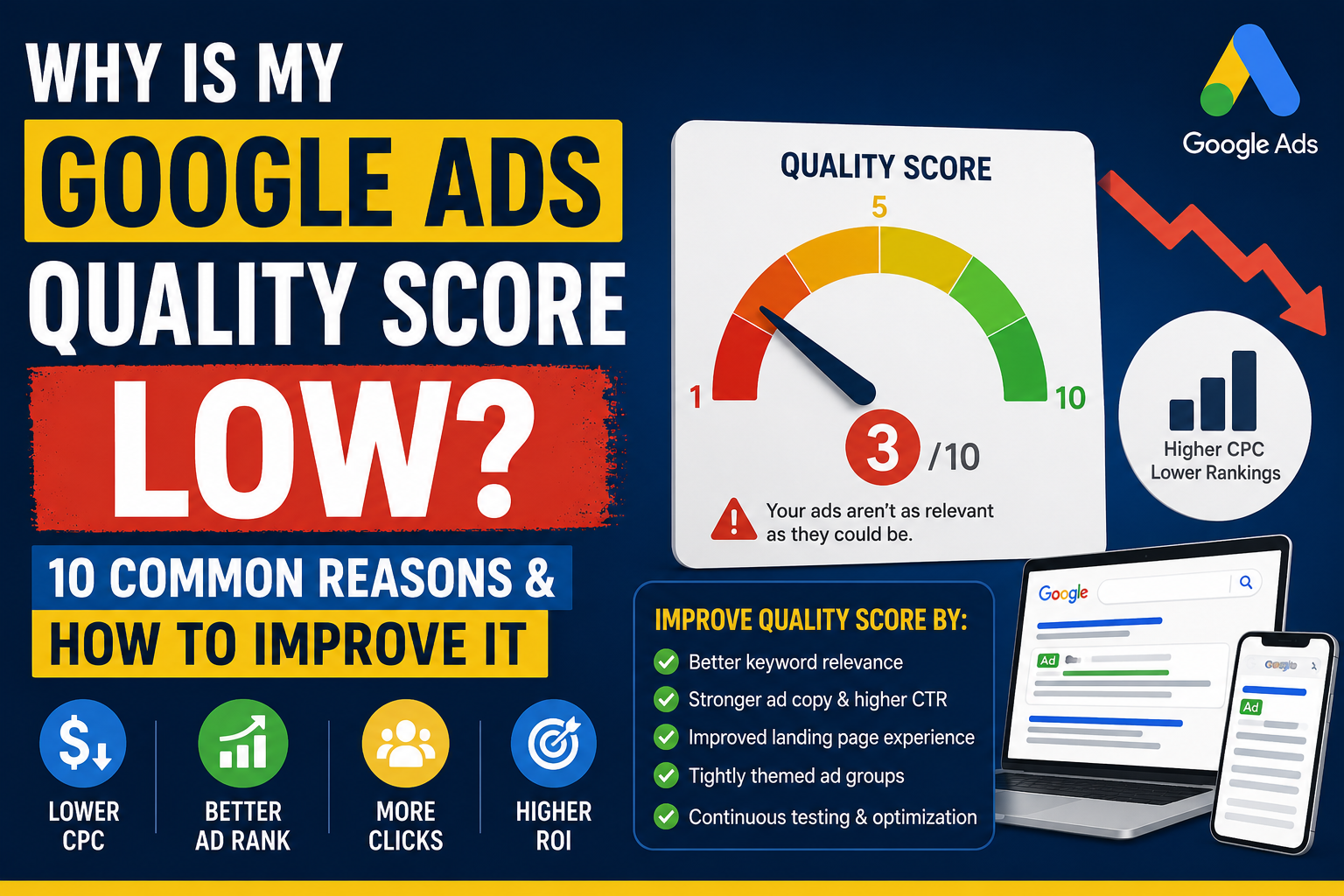
Google Ads Quality Score Low? If you’ve noticed that your Google Ads campaigns have a low Quality Score, you’re probably wondering what caused it and whether it actually matters.
The good news is that a low Quality Score isn’t permanent. It’s simply Google’s way of indicating that your keywords, ads, or landing pages aren’t providing the best possible experience for users.
A higher Quality Score can help improve your ad positions, reduce your Cost Per Click (CPC), and increase the overall efficiency of your campaigns. While it’s not the only metric that determines success, understanding why your Quality Score is low can uncover opportunities to improve campaign performance.
Let’s look at the most common reasons and how to fix them.
1. Your Keywords Don’t Match Your Ads
Google wants users to see ads that closely match what they’re searching for.
If someone searches for Google Ads Consultant but your ad talks generally about digital marketing services, Google considers your ad less relevant.
How to fix it
- Group similar keywords together.
- Use tightly themed ad groups.
- Include important keywords naturally in your headlines and descriptions.
2. Your Landing Page Doesn’t Match the Ad
Your landing page should continue the conversation started by your ad.
For example, if your ad promotes a Free Google Ads Audit, visitors should land directly on your audit page—not your homepage.
How to fix it
- Match landing page content to your ad.
- Keep messaging consistent.
- Make your offer easy to find.
- Improve page speed and mobile experience.
3. Your Click-Through Rate Is Lower Than Expected
Google estimates how likely users are to click your ads.
If your ads receive fewer clicks than expected, your Quality Score may decrease.
How to fix it
- Write stronger headlines.
- Include your primary keyword.
- Highlight your unique selling proposition.
- Test multiple Responsive Search Ads.
4. You’re Targeting Broad Keywords
Broad keywords can trigger your ads for irrelevant searches.
This often reduces CTR because users don’t find your ads relevant.
How to fix it
- Use Phrase Match or Exact Match where appropriate.
- Add negative keywords.
- Review your Search Terms Report regularly.
5. Your Ad Copy Doesn’t Stand Out
Users compare several ads before clicking.
If your ad looks similar to everyone else’s, they may choose another advertiser.
Instead of writing:
Professional Google Ads Services
Try:
Google Ads Consultant with 20+ Years Experience
or
Reduce Wasted Ad Spend with a Free Google Ads Audit
Specific benefits usually outperform generic statements.
6. Your Landing Page Experience Needs Improvement
Google also evaluates how useful your landing page is.
Common problems include:
- Slow loading pages
- Poor mobile usability
- Difficult navigation
- Weak calls-to-action
- Thin or irrelevant content
A better user experience often improves Quality Score while increasing conversions.
7. Your Ad Groups Are Too Large
Many advertisers place dozens of unrelated keywords into one ad group.
This makes it difficult to write highly relevant ads.
Instead:
Create smaller, tightly themed ad groups with closely related keywords.
8. You’re Not Testing Your Ads
Google Ads isn’t a “set and forget” platform.
Successful advertisers continually test:
- Headlines
- Descriptions
- Calls-to-action
- Offers
Small improvements in CTR often lead to better Quality Scores over time.
9. You’re Focusing Only on Bids
Increasing bids won’t automatically improve Quality Score.
Google rewards relevance—not simply higher spending.
Before increasing your budget, improve:
- Keyword relevance
- Ad copy
- Landing pages
- User experience
10. You’re Chasing Quality Score Instead of Business Results
A perfect Quality Score doesn’t guarantee profitable campaigns.
Your primary goal should always be:
- More qualified leads
- Lower Cost Per Acquisition (CPA)
- Higher Return on Ad Spend (ROAS)
- Better overall return on investment
Quality Score is an important diagnostic metric—not the final objective.
Final Thoughts
A low Google Ads Quality Score usually points to opportunities for improvement rather than campaign failure.
By creating tightly themed ad groups, writing relevant ads, improving landing pages, and continuously testing your campaigns, you can often increase Quality Score while reducing advertising costs and improving overall performance.
If you’re unsure what’s affecting your Quality Score, a professional Google Ads Audit can identify issues, reduce wasted ad spend, and help your campaigns perform more efficiently.
Frequently Asked Questions
What is a good Quality Score in Google Ads?
Quality Scores range from 1 to 10. Generally, scores of 7–10 are considered good, while scores below 5 often indicate opportunities for improvement.
Does a low Quality Score increase CPC?
Yes. Lower Quality Scores can result in higher Cost Per Click because Google may require higher bids for lower-quality ads to compete in the auction.
Can I improve my Quality Score?
Absolutely. Improving keyword relevance, ad copy, expected CTR, landing page experience, and account structure can all contribute to higher Quality Scores.
Is Quality Score more important than conversions?
No. While Quality Score helps improve campaign efficiency, your ultimate goal should always be generating profitable leads and sales.